
FR4 CNC machining presents different challenges from machining homogeneous engineering plastics. Its woven glass-fiber reinforcement increases abrasiveness, while the laminated epoxy structure makes holes, slots, and cut edges more sensitive to machining conditions. For prototype and low-volume parts, tool condition and edge integrity can therefore influence quality just as much as machine positioning accuracy.
The Glass-Fiber Laminate Structure Defines FR4 Machining Behaviour
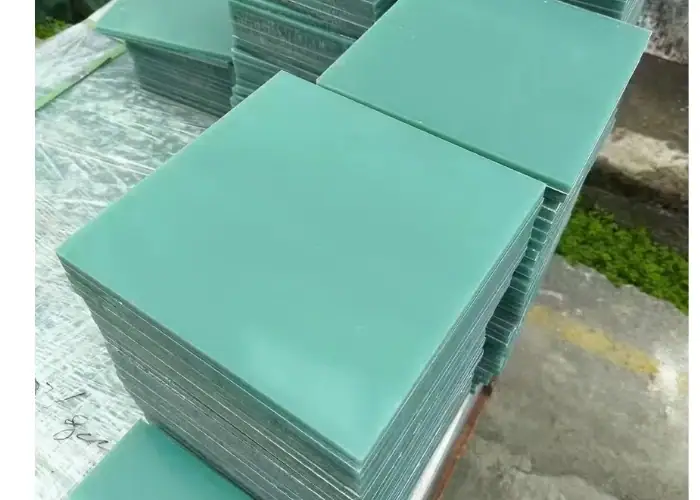
FR4 is not a uniform thermoplastic. Its woven glass fiber and epoxy resin respond differently during cutting, so machining quality depends on how both materials behave together. This structure explains why tool wear, edge integrity, and feature quality require more attention than with many standard plastics.
Glass Fiber Increases Abrasiveness and Tool Wear
Glass fiber improves FR4 strength and rigidity, but it also increases abrasiveness during machining. As cutting tools wear, the machining condition changes, which can gradually influence hole quality, edge finish, and dimensional consistency across a batch.
The Laminate Structure Makes Edge Integrity More Sensitive
Because FR4 is built from reinforced layers rather than a single homogeneous material, cut edges, holes, slots, and thin sections require stable machining conditions. Poor edge integrity can affect assembly, fastening, or inspection even when the nominal dimensions are correct.
Design Features That Deserve Extra Attention in FR4 Parts
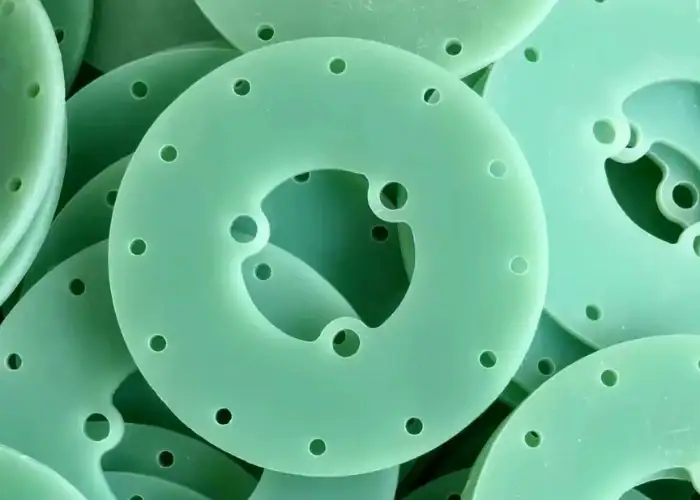
FR4 parts often contain dense hole patterns, slots, cutouts, and mounting features. These details are common in insulation plates, fixtures, electrical supports, and structural panels, so reviewing them before machining helps reduce avoidable manufacturing problems.
Small Holes, Narrow Slots, and Closely Spaced Features
Small holes and narrow slots can be more sensitive to tool condition and laminate behaviour. Closely spaced features may also leave limited material support between machining operations, so their spacing and sequence should be reviewed before production.
Functional Tolerances Should Be Prioritized
Tolerance control should focus on features that directly affect function, such as hole locations, mounting interfaces, alignment surfaces, and insulation spacing. Applying equally tight tolerances to every dimension can increase machining difficulty without improving the engineering value of the part.
Tool Wear Is a Process Variable in FR4 CNC Machining
Tool wear is not only a maintenance issue when machining FR4. Because the glass fiber is abrasive, changes in tool condition can directly change the quality of machined features. For prototype and low-volume batches, this makes tool condition part of process control.
Worn Tools Can Change Hole and Edge Quality
As tools wear, cutting quality may change around holes, slots, and cut profiles. Engineers should therefore evaluate not only dimensional results but also whether edge quality remains stable throughout the machining batch.
Tool Condition Can Affect Batch Consistency
A first-off sample may look excellent while later components show gradual quality changes if tool wear is not controlled. For multiple-part builds, consistent tool condition helps reduce variation between samples and makes machining results easier to compare.
Hole and Edge Quality Can Matter More Than Cosmetic Finish
Many FR4 components are functional rather than decorative. For these parts, clean holes, stable cut edges, and accurate mounting features often matter more than achieving a cosmetic surface. Quality evaluation should therefore reflect how the part will actually be assembled and used.
Hole Quality Affects Fastening and Alignment
Mounting holes often determine how FR4 parts align with surrounding components. Poor hole edges or inconsistent diameters can influence fastening, positioning, and assembly repeatability even if the rest of the part is dimensionally correct.
Clean Edges Support Assembly and Inspection
Clean cut edges make FR4 parts easier to inspect, assemble, and handle. Edge damage or roughness may interfere with mating surfaces or create misleading inspection results, so edge condition should be reviewed as a functional quality feature.
Dust Management Is Part of the FR4 Machining Process
FR4 machining generates fine abrasive dust from the glass-fiber epoxy structure. Dust management affects more than workshop cleanliness; it also supports equipment maintenance, part cleanliness, surface condition, and reliable inspection after machining. For this reason, dust extraction and handling should be considered part of the manufacturing process rather than a separate housekeeping task.
Common Mistakes in FR4 CNC Machining
| Common Mistake | Better Engineering Approach |
| Ignoring abrasive glass fiber | Include tool condition in process planning |
| Checking dimensions but not hole edges | Evaluate holes, slots, and cut profiles together |
| Treating cosmetic finish as the main quality target | Prioritize functional edges and mounting features |
| Ignoring dust during machining and inspection | Include dust management in the machining process |
| Assuming tool condition stays constant | Monitor quality as tool wear develops |
Conclusion
FR4 CNC machining requires special attention because glass fiber changes tool wear, edge behaviour, and machining consistency. Rather than focusing only on dimensional accuracy, engineers should also evaluate tool condition, hole and slot quality, laminate edges, and dust management. These factors provide a more realistic basis for assessing FR4 machining quality.
FAQs
1. Why Does FR4 Cause More Tool Wear Than Standard Plastics?
Glass fiber is more abrasive than many common plastic materials, so cutting tools can wear faster during FR4 machining.
2. Can FR4 Be CNC Machined Accurately?
Yes. Accurate FR4 machining is achievable when tool condition, part geometry, machining strategy, and inspection requirements are properly controlled.
3. Why Is Edge Quality Important in FR4 Parts?
Edge quality affects assembly, fastening, handling, and inspection, especially around holes, slots, and mounting features.
4. Does Tool Wear Affect FR4 Hole Accuracy?
Yes. Changes in tool condition can influence hole diameter, edge quality, and consistency across multiple parts.
5. Why Does FR4 CNC Machining Produce So Much Dust?
FR4 contains woven glass fiber and epoxy resin. Cutting this laminate creates fine abrasive particles that require effective dust control.
6. What Features Should Engineers Review Before Machining FR4?
Engineers should pay particular attention to small holes, narrow slots, closely spaced features, mounting interfaces, functional tolerances, and critical cut edges.