
When engineers need a material that balances strength, wear resistance, and machining efficiency, nylon is often one of the first options considered. From functional prototypes to mechanical components, nylon offers a practical combination of performance and cost-effectiveness. In this guide, I will explain how nylon behaves during CNC machining, where it performs best, and how to design better nylon parts for real-world applications.
Why Nylon Remains a Popular Material for Machined Prototypes?
Among engineering plastics, nylon continues to be widely used because it delivers reliable mechanical performance while remaining relatively easy to machine.
Balancing Strength, Weight, and Cost
Many prototype projects require a material that is strong enough for testing but does not significantly increase manufacturing cost. Nylon provides a favorable strength-to-weight ratio, making it suitable for many mechanical and industrial applications.
Suitable for Repeated Mechanical Testing
Unlike appearance-only models, functional prototypes are often subjected to repeated movement, assembly, and load testing. Nylon can withstand these validation activities while maintaining reliable performance.
A Practical Alternative to Metal Components
In some applications, nylon can replace metal parts to reduce weight, lower noise, and simplify manufacturing. This is especially common in motion-related components.
Understanding Nylon Properties Before Machining
Understanding material behavior before manufacturing helps engineers avoid costly design revisions later in development.
Wear Resistance and Low Friction
One of nylon’s biggest advantages is its ability to perform well in moving assemblies. The material naturally offers low friction and good wear resistance, making it suitable for dynamic applications.
Impact Resistance and Toughness
Many machined plastic parts experience accidental impacts during assembly and testing. Nylon’s toughness allows it to absorb these forces without cracking easily.
Moisture Absorption Considerations
Unlike some engineering plastics, nylon absorbs moisture from the surrounding environment. Engineers should consider this characteristic when designing parts that require high dimensional stability.
Choosing the Right Nylon Grade for Your Project
Different nylon grades behave differently during CNC machining. When I select nylon for a prototype or mechanical component, I do not only compare strength. I also consider machinability, moisture absorption, dimensional stability, stiffness, wear resistance, and the final application environment.
Nylon Grade Comparison for CNC Machining
| Nylon Grade | Machining Performance | Key Advantages | Main Considerations | Best For |
| Nylon 66 | Better strength and heat resistance | Higher stiffness, better wear resistance, stronger load-bearing ability | Slightly more demanding machining control than Nylon 6 | Structural parts, gears, bushings, load-bearing components |
| Glass-Filled Nylon | More rigid but more abrasive to machine | Higher stiffness, improved dimensional stability, better structural support | More tool wear; less flexible; not ideal for impact-sensitive designs | High-rigidity parts, support structures, industrial components |
| Cast Nylon | Stable for larger machined parts | Lower internal stress, good wear performance, suitable for larger components | Material availability and grade selection should be confirmed early | Large wear parts, rollers, guide blocks, mechanical components |
| Extruded Nylon | Economical and widely available | Cost-effective, suitable for many standard parts | May have more internal stress than cast nylon | Standard prototypes, simple machined parts |
Nylon 6 for General Prototyping
Nylon 6 is often selected when the project needs a balanced material for general mechanical testing. It offers good toughness, impact resistance, and machinability, making it suitable for early functional prototypes and lower-load parts.
However, engineers should consider its moisture absorption and lower heat resistance compared with Nylon 66. For precision assemblies, I would review the operating environment before selecting Nylon 6.
Nylon 66 for Higher Mechanical Loads
Nylon 66 is usually a better choice when a part requires higher stiffness, better wear resistance, and improved heat performance. It is commonly used for gears, bushings, rollers, spacers, and load-bearing components.
For CNC machining projects, Nylon 66 can provide more reliable performance in demanding mechanical applications. It is especially useful when the prototype must closely represent real operating conditions.
Glass-Filled Nylon for Increased Rigidity
Glass-filled nylon is selected when stiffness and dimensional stability are more important than flexibility. The glass fiber reinforcement helps reduce deformation and improves structural support.
However, glass-filled nylon is more abrasive during machining. This means tool wear, edge quality, and machining strategy must be controlled more carefully. I would not recommend it for parts that require high impact flexibility.
Cast Nylon vs Extruded Nylon
Cast nylon is often preferred for larger machined components because it usually has lower internal stress and better dimensional behavior during machining. It is suitable for large wear parts, rollers, guide blocks, and industrial mechanical parts.
Extruded nylon is more economical and widely available, making it suitable for standard prototypes and simpler parts. For highly precise or large components, I would review whether cast nylon is a better option before production.
How I Recommend Selecting Nylon Grades?
For general functional prototypes, Nylon 6 is often a practical starting point. For parts under higher mechanical loads, Nylon 66 is usually more suitable. For applications that require stronger rigidity and improved dimensional stability, glass-filled nylon may be considered.
At UForProto, I prefer to review the part geometry, load conditions, tolerance requirements, and testing environment before recommending a nylon grade. This helps avoid over-specifying materials while still ensuring the part performs reliably during validation.
What Can Be Manufactured with CNC Machined Nylon?
The combination of durability, wear resistance, and machining efficiency allows nylon to be used in a wide variety of engineering applications.
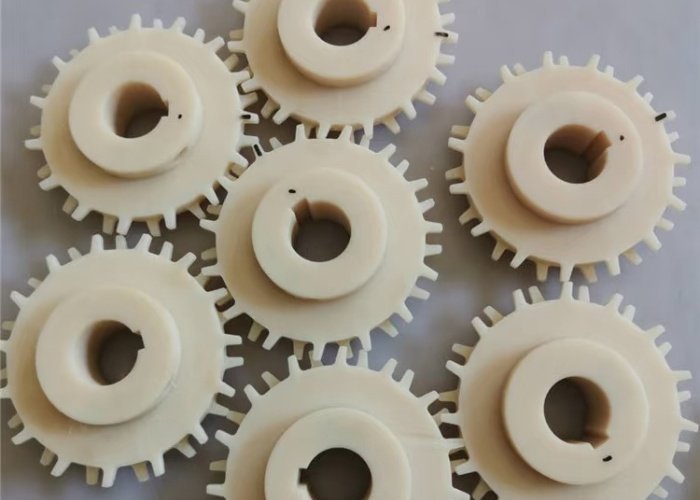
Gears and Power Transmission Components
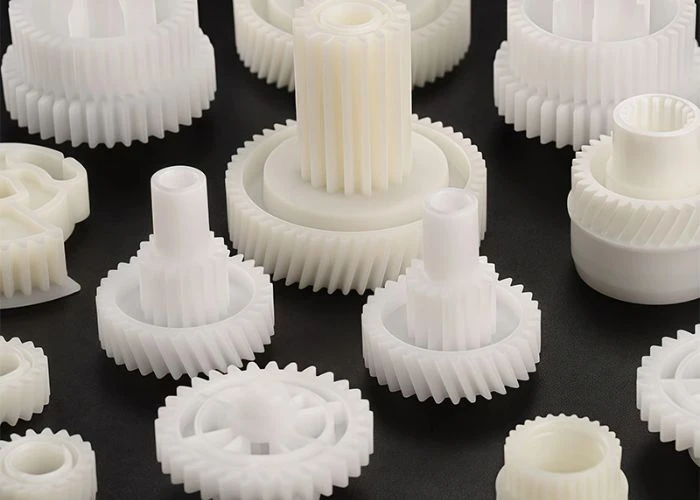
Nylon is frequently used for gears, sprockets, and transmission components because it provides good wear resistance while helping reduce operating noise. In many prototype projects, engineers use nylon gears to evaluate mechanical motion before investing in production tooling.
Bushings, Rollers, and Wear Parts
Components that experience repeated movement or friction often benefit from nylon’s low-friction characteristics. Bushings, rollers, and guide components are common examples.
Industrial Equipment Components
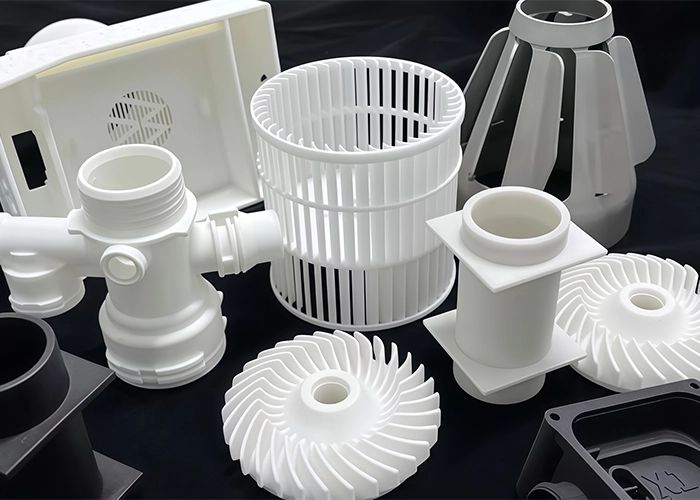
Many industrial machines use machined nylon parts for covers, guides, supports, and motion-related structures. The material offers a practical balance between performance and manufacturing cost.
Functional Prototype Assemblies
For product developers, nylon is often selected for prototype assemblies that require repeated testing, mechanical validation, and assembly evaluation before production.
Machining Considerations for Nylon Parts
Although nylon is one of the most machinable engineering plastics, achieving consistent results requires more than simply selecting the right material. Engineers should understand how nylon behaves during machining and how manufacturing strategies can influence final part quality, dimensional stability, and long-term performance.
Managing Heat During Machining
One characteristic that distinguishes nylon from metals is its relatively low thermal conductivity. During machining, generated heat is not transferred away as efficiently as it is with aluminum or steel. Instead, part of the heat remains concentrated near the cutting zone.
When excessive heat accumulates, the material may temporarily soften. Engineers may observe reduced dimensional consistency, poor surface finish, or slight deformation in thin sections.
To reduce these risks, machining strategies should prioritize stable cutting conditions and efficient chip evacuation. At UForProto, we typically optimize machining parameters based on part geometry and material grade to maintain consistent cutting temperatures throughout the process.
Controlling Deformation in Flexible Components
Compared with many rigid plastics, nylon offers greater toughness and flexibility. While this characteristic improves impact resistance, it can also make certain geometries more sensitive during machining.
Long unsupported sections, thin walls, and asymmetrical features may react differently to machining forces. Parts that appear dimensionally correct during machining can sometimes exhibit slight movement after fixture release.
To improve stability, engineers should avoid unnecessary thin features and maintain balanced geometry whenever possible. During production, proper fixturing strategies and staged machining operations help reduce internal stress and improve dimensional consistency.
Planning Tolerances Around Real Material Behavior
Many engineers are familiar with achieving tight tolerances in metal components. However, applying the same approach directly to nylon can increase manufacturing complexity without improving product performance.
Critical dimensions such as bearing fits, shaft locations, and assembly interfaces may require tighter control. Non-functional surfaces, however, can often use more practical tolerances without affecting performance.
At UForProto, we often review customer drawings before production to identify dimensions that truly require precision control and those that can be optimized for manufacturability.
Accounting for Moisture Absorption
Unlike many engineering plastics, nylon absorbs moisture from the surrounding environment. This behavior is not a manufacturing defect but an inherent material characteristic.
For applications requiring precise fits or long-term dimensional stability, environmental conditions should be considered during product development. Humidity, storage conditions, and operating environments can all influence part dimensions over time.
A practical solution is to evaluate nylon parts under conditions similar to their intended application. This provides more realistic validation results and reduces unexpected dimensional changes later in the product lifecycle.
Improving Machining Efficiency Through Better Geometry
Part geometry has a direct impact on machining time, manufacturing cost, and final part quality. Features that are difficult to access often require additional setups and more complex machining strategies.
Deep pockets, narrow slots, and unnecessary internal features may increase machining difficulty without adding functional value.
By considering manufacturability early in the design process, engineers can simplify machining, shorten lead times, and improve overall prototype quality.
Preparing Nylon Parts for Assembly
Many nylon components are ultimately integrated into larger assemblies. Features such as threaded holes, mating surfaces, alignment points, and fastening locations should be evaluated before machining begins.
Assembly-related issues are often discovered only after prototype manufacturing is complete, leading to unnecessary redesign cycles and additional costs.
Reviewing assembly requirements during the engineering stage helps ensure that prototype parts accurately represent the final product and support more effective validation testing.
Machining Requirements for High-Quality Nylon Parts
Producing accurate nylon components is not only about selecting the right material. Tooling, cutting conditions, chip evacuation, and process control all influence final part quality. Understanding these factors helps engineers achieve more consistent machining results and reduce prototype development risks.
Selecting the Right Cutting Tools
Nylon is generally easy to machine, but different nylon grades can place different demands on cutting tools. Standard nylon materials are commonly machined using sharp high-speed steel or carbide tools. For glass-filled nylon, carbide tooling is often preferred because abrasive glass fibers can accelerate tool wear.
Rather than focusing on tool material alone, maintaining a sharp cutting edge is often more important for achieving consistent surface quality and dimensional accuracy.
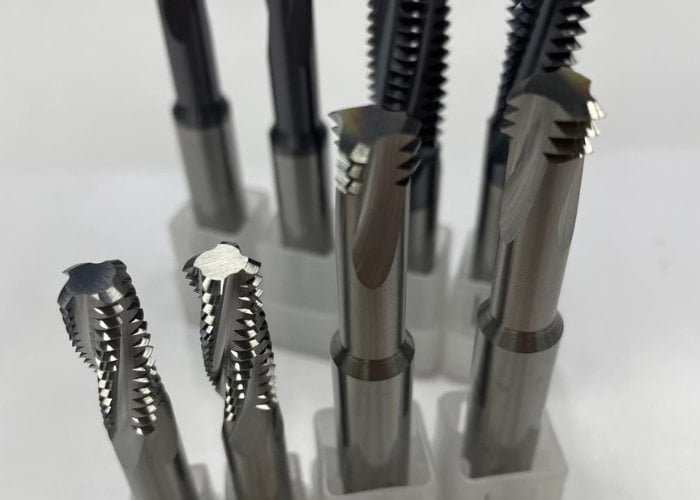
Tool Geometry Influences Surface Quality
The geometry of a cutting tool plays a significant role when machining nylon. Tools designed to reduce cutting forces help prevent excessive heat generation and minimize material deformation.
Features such as polished flutes and efficient chip evacuation help keep cutting zones clean and reduce the possibility of material adhesion on the tool edge.
Stable Cutting Conditions Matter More Than Maximum Speed
Many engineers assume faster machining automatically improves efficiency. In nylon machining, however, excessive cutting speed may increase heat generation and negatively affect dimensional stability.
The goal is not maximum spindle speed but maintaining stable cutting conditions that balance productivity, surface finish, and dimensional accuracy.
Effective Chip Removal and Cooling
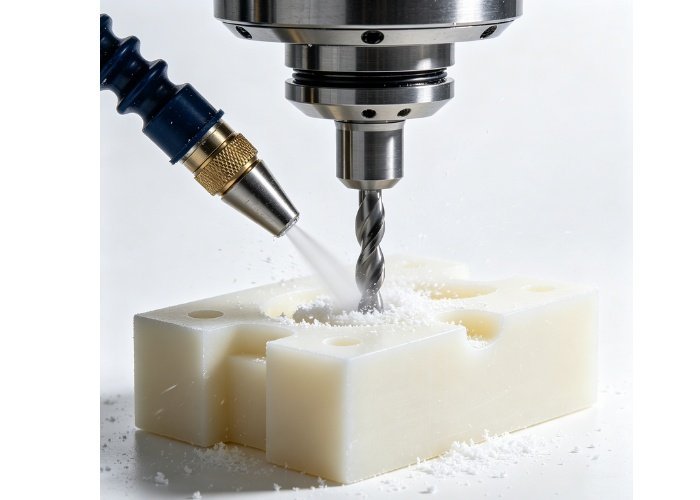
Because nylon retains heat more easily than metal, efficient chip removal is an important part of process control. Chips left in the cutting zone can increase friction and cause unnecessary heat buildup.
For many nylon machining applications, compressed air is commonly used to help clear chips and maintain stable cutting conditions. This approach also helps avoid introducing unnecessary moisture into the material.
Tool Condition Directly Affects Part Quality
As cutting edges wear, machining quality often changes before the operator notices visible tool damage. Surface finish, dimensional consistency, and burr formation can all be affected.
Regular tool inspection is particularly important when machining glass-filled nylon because reinforced materials typically generate greater tool wear.
Process Control Is More Important Than Individual Parameters
Successful nylon machining is rarely the result of one specific cutting speed or tool selection. Instead, it depends on how tooling, machining strategy, cooling, fixturing, and material behavior work together.
How UForProto Supports Nylon Prototype Development?
As a professional plastic prototype manufacturer, we help engineers develop reliable nylon prototype parts from concept through validation.we evaluate multiple factors together during engineering review to help customers achieve reliable prototype performance and repeatable manufacturing results.
Engineering Review Before Manufacturing
Our engineering team reviews part geometry, material requirements, and tolerance specifications before production begins. This helps identify potential manufacturing issues early.
Precision CNC Plastic Machining
With extensive experience machining engineering plastics, we help customers produce high-quality nylon parts suitable for testing, validation, and product development.
Prototype Assembly Support
In addition to machining services, we also provide prototype assembly support to help customers evaluate complete product designs.
Fast Quotation and Delivery
Our streamlined engineering review process allows customers to receive fast quotations and shorter prototype lead times.
Conclusion
Nylon continues to be one of the most practical materials for CNC machining because it offers an excellent balance of strength, wear resistance, and manufacturing flexibility. Whether used for gears, bushings, industrial components, or functional prototypes, nylon helps engineers evaluate real-world performance while maintaining reasonable development costs.
Planning a nylon machining project? Send us your 3D files for expert support and a fast quote.
FAQs
1.Is nylon easy to machine?
Yes. Nylon is considered one of the most machinable engineering plastics. It can be milled, turned, drilled, and tapped efficiently while maintaining good dimensional accuracy.
2.What is the best way to machine nylon?
The best way to machine nylon is to use sharp cutting tools, optimized cutting parameters, and proper workholding to minimize heat buildup and material deformation. Because nylon is softer and more flexible than metal, excessive cutting forces and high temperatures can affect dimensional accuracy and surface quality. CNC milling and turning are the most common methods for producing precise nylon parts, while proper deburring and finishing help achieve better edge quality and assembly performance.
3.Is nylon suitable for functional prototypes?
Yes. Nylon is widely used for functional prototypes because of its durability, wear resistance, and mechanical performance.
4.Can nylon parts be CNC machined with tight tolerances?
Yes, but engineers should consider moisture absorption and environmental conditions when defining critical dimensions.
5.What industries commonly use machined nylon parts?
Machined nylon parts are commonly used in industrial equipment, automation systems, consumer products, medical devices, robotics, and transportation equipment.