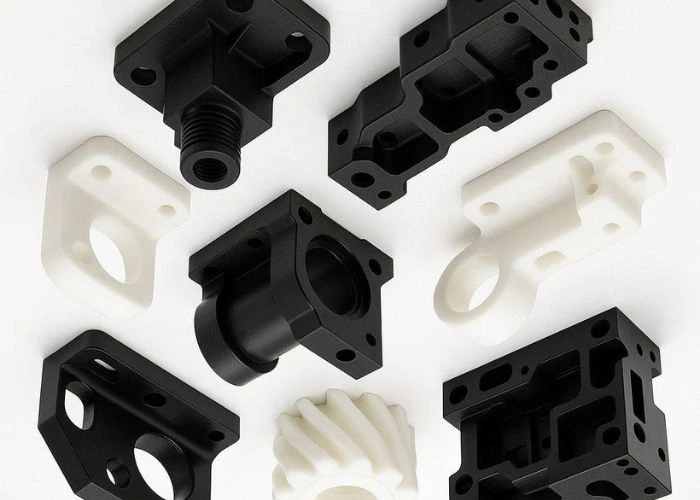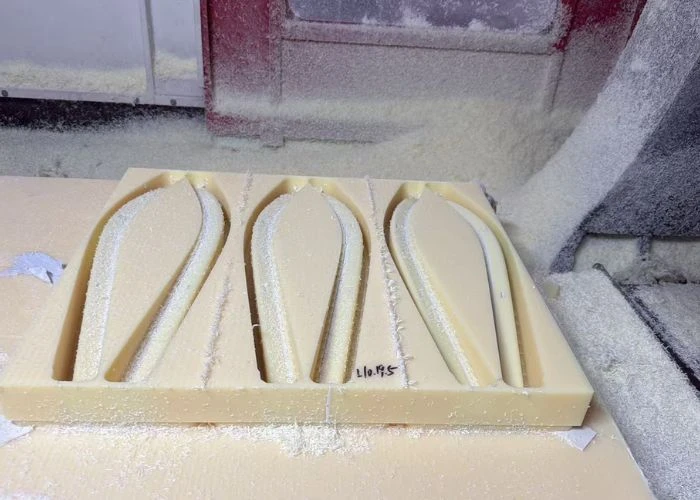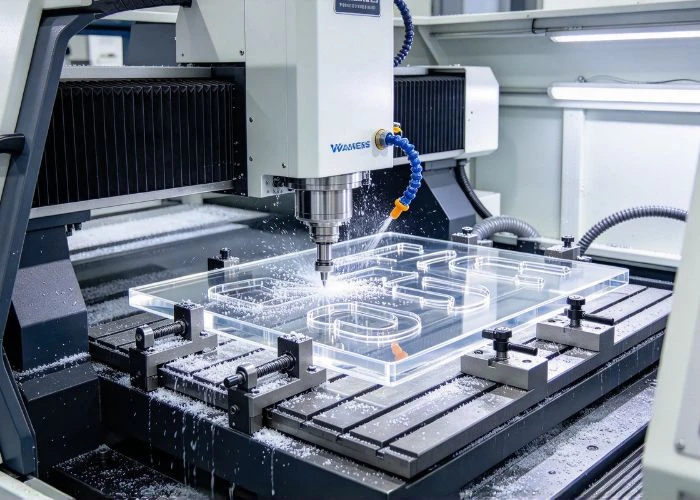

Choosing between PVC vs ABS for CNC prototyping is not simply a question of which plastic is stronger or easier to machine. Both materials can produce accurate prototypes, but they respond differently to impact, chemical exposure, temperature, assembly loads, and cosmetic finishing. A material that works well for a chemical-resistant fixture may be unsuitable for a frequently handled product housing. In our plastic prototyping work, we compare these differences against the prototype’s intended function, manufacturing requirements, and future production goals to help engineers make informed material decisions.
What Is the Difference Between PVC and ABS in CNC Prototyping?
Rigid PVC and ABS are both thermoplastics used in industrial and product development applications, but their engineering advantages are different. PVC is generally valued for chemical resistance, rigidity, and certain electrical insulation applications, while ABS is widely chosen for impact resistance, durability, and appearance-related requirements. For CNC prototyping, the important question is not which material has more advantages overall, but which properties are essential for the component being developed.
Rigid PVC, commonly identified as PVC-U or uPVC, contains little or no plasticizer and is different from flexible PVC used in cables, flexible tubing, and soft products. Its relatively high stiffness and resistance to many compatible aqueous chemicals make it suitable for selected industrial components. ABS, or acrylonitrile butadiene styrene, is a different polymer system whose balance of rigidity and toughness makes it useful for equipment housings, instrument covers, and repeatedly handled components. Comparing flexible PVC with rigid ABS stock would therefore produce misleading conclusions, so our discussion focuses on rigid PVC and general-purpose or machining-grade ABS.
The difference becomes clearer when we consider two prototypes with similar geometry. A stationary support inside chemical-processing equipment may prioritize resistance to cleaning solutions and dimensional rigidity. A handheld instrument enclosure with the same wall thickness may instead require impact toughness, reliable fastening, and a painted exterior. Although both components can be CNC machined, their operating conditions create different material priorities. We therefore recommend defining the prototype’s primary failure risk before comparing supplier datasheets. This prevents a material from being selected solely because one numerical property appears better than the alternative.
PVC vs ABS: Which Material Has Better Mechanical Properties?
Mechanical performance is often the first factor engineers compare when choosing between PVC and ABS. However, stiffness, tensile strength, impact resistance, and long-term load behavior describe different responses to mechanical stress. A material that resists bending effectively may still be vulnerable to sudden impact or stress concentration. We evaluate these properties separately because the correct choice depends on how the prototype will actually be loaded during assembly, handling, and operation.
Stiffness and Strength Under Static Loads
Rigid PVC generally provides greater stiffness than many standard ABS grades. For example, common material reference data report a flexural modulus of approximately 2.8–3.1 GPa for some rigid PVC grades, compared with roughly 2.1 GPa for a representative general-purpose ABS grade. These values illustrate a typical difference, not a guaranteed specification for every product. Under comparable geometry and loading, a stiffer material usually exhibits less elastic deflection, which can be useful for fixed brackets, insulating supports, or panels where maintaining shape is more important than absorbing impact.
However, greater stiffness does not automatically mean that PVC can carry every load more safely. Tensile strength, creep resistance, fastening geometry, and local stress concentrations must also be considered. For instance, a thin panel supported at four corners behaves differently from a compact block under compression, even if both are made from the same material. We therefore avoid selecting a material from elastic modulus alone. Instead, we examine the load direction, support conditions, expected deformation, and the consequences of failure before deciding whether PVC’s additional rigidity provides a meaningful advantage.
Impact Resistance and Resistance to Cracking
ABS generally has a significant advantage when a component must withstand accidental drops, repeated handling, or sudden mechanical impacts. The butadiene phase in ABS contributes to energy absorption and improves toughness compared with many conventional rigid PVC grades. This matters particularly for handheld instruments, protective covers, and housings that may be struck during installation or service. A prototype can satisfy its dimensional requirements yet still fail if the material cracks around a mounting hole or a thin corner after impact.
Impact resistance must nevertheless be interpreted carefully. Test results depend on the test method, specimen thickness, temperature, notch geometry, and material grade. An impact-modified PVC formulation may perform substantially better than standard rigid PVC, while different ABS grades can also vary widely. We recommend using grade-specific notched impact data when the design contains screw bosses, openings, sharp transitions, or other potential crack-initiation points. Where impact loading is critical, material datasheets should support the initial selection, but application-specific validation remains necessary.
External technical reference : Curbell Plastics — ABS Material Properties provides representative ABS impact, stiffness, and thermal data, including grade-specific cautions.
PVC vs ABS Material Comparison Table for CNC Prototyping
A comparison table is useful only when the properties are interpreted in the context of prototype requirements. The following values and descriptions represent common engineering tendencies for rigid PVC and general-purpose ABS. They are intended for preliminary screening, not final material certification. We recommend requesting the exact grade datasheet before using numerical values for structural calculations, regulatory decisions, or production specifications.
Reference :Curbell Plastics ABS technical data;Ready Plastics PVC vs ABS comparison。
The table highlights an important distinction: the material with the better individual property is not necessarily the better prototype material. PVC may offer a stiffness advantage in a fixed support, but that benefit may be irrelevant if the component must survive repeated drops. Likewise, ABS may provide excellent toughness while being unsuitable for prolonged contact with a particular chemical. We therefore use material comparisons to eliminate unsuitable candidates first, then assess the remaining materials against the prototype’s actual requirements.
Which Material Offers Better Chemical and Temperature Resistance?
Environmental conditions can be more important than mechanical strength when choosing between PVC and ABS. Chemical exposure, cleaning procedures, temperature, and operating duration all influence material suitability. A plastic that performs well during a short prototype demonstration may behave differently after prolonged exposure to a demanding environment. We therefore evaluate the intended service conditions before recommending either material for chemically exposed or temperature-sensitive components.
Rigid PVC is often preferred for components exposed to compatible aqueous acids, alkalis, and certain industrial cleaning solutions. Its chemical resistance makes it relevant to laboratory fixtures, fluid-handling supports, and selected industrial equipment components. ABS is generally less suitable for contact with certain organic solvents, including ketones, which can cause surface damage or environmental stress cracking. However, it would be incorrect to assume that PVC resists every chemical or that ABS is incompatible with all cleaning agents. Chemical performance depends on the exact substance, concentration, exposure time, temperature, and mechanical stress applied to the part.
Temperature introduces a separate selection requirement. Many general-purpose ABS grades offer a higher heat-deflection temperature than standard rigid PVC, making ABS a potential option for certain equipment housings exposed to moderate heat. However, heat-deflection temperature is measured under specified laboratory conditions and should not be confused with a guaranteed continuous operating temperature. Components under sustained mechanical loads may deform at temperatures below their published heat-deflection values. We recommend evaluating continuous-service ratings, local heat sources, assembly loads, and the material supplier’s temperature data together.
For example, consider a protective cover installed near a warm electrical component and cleaned regularly with a chemical solution. ABS may offer an advantage in impact resistance and heat performance, while PVC may offer better resistance to the cleaning chemistry. Neither advantage resolves the decision independently. The engineering team must determine whether chemical exposure, operating temperature, or impact loading represents the greater risk. If neither material satisfies the complete requirement, a third engineering plastic should be considered rather than forcing the design into a PVC-versus-ABS choice.
The PVC vs ABS material comparison from Ready Plastics provides additional context on how chemical exposure, impact requirements, and finishing needs influence material selection.
Is PVC or ABS Better for CNC-Machined Prototypes?
Both materials can be milled, drilled, and turned into functional geometries, but the best choice depends on the purpose of the prototype. Instead of repeating detailed cutting parameters, we focus on how material selection affects manufacturing consistency, stock availability, and the usefulness of prototype results. These considerations are especially important when engineers need the machined component to represent a future production design.
ABS is widely available in sheets and rods intended for machining, including grades developed for improved consistency and dimensional stability. This can make it a practical choice for equipment housings, assembly fixtures, covers, and prototypes with multiple mating features. Rigid PVC is also machinable, but its stock grade and material condition must be evaluated for the intended geometry and operating environment. Neither material should be assumed to achieve a particular tolerance solely because it is listed as easy to machine. Geometry, stock quality, fixturing, and inspection conditions still influence the finished result.
One important question is whether the prototype is intended to verify geometry or material-dependent performance. If an engineering team only needs to confirm that mounting holes align and a cover fits over an assembly, a substitute material may provide useful information. If the purpose is to assess impact behavior, chemical compatibility, or temperature-related deformation, the material itself becomes part of the validation. In those cases, replacing PVC with ABS—or the reverse—can change the meaning of the test. We recommend recording the prototype’s material grade and the limitations of any substitution before interpreting the results.
The manufacturing method also matters when a CNC prototype is used to represent a future molded product. CNC machining removes material from solid stock, whereas molding can introduce different molecular orientation, residual stress, and feature characteristics. A machined ABS prototype may be excellent for checking dimensions, appearance, and assembly, but it does not automatically reproduce the mechanical behavior of an injection-molded ABS part. The same caution applies to PVC. Engineers should identify which prototype conclusions can be transferred to production and which require separate validation.
For engineers who have already selected PVC, our guide to PVC CNC machining examines cutting challenges, tolerance control, and design considerations in greater detail.
External technical reference : Curbell Plastics — Easy-to-Machine Plastic Materials compares engineering plastics commonly selected for milling, drilling, and turning.
Which Material Is Better for Cosmetic Prototypes and Assembly Validation?
For many product development projects, the prototype must do more than demonstrate a basic shape. Engineers and industrial designers may need to evaluate appearance, color consistency, fastening behavior, assembly gaps, and the experience of handling the product. These requirements often influence material selection more strongly than small differences in nominal strength. We consider how the material will perform throughout finishing and assembly, not only how it behaves during CNC machining.
Cosmetic Finishing and Surface Appearance
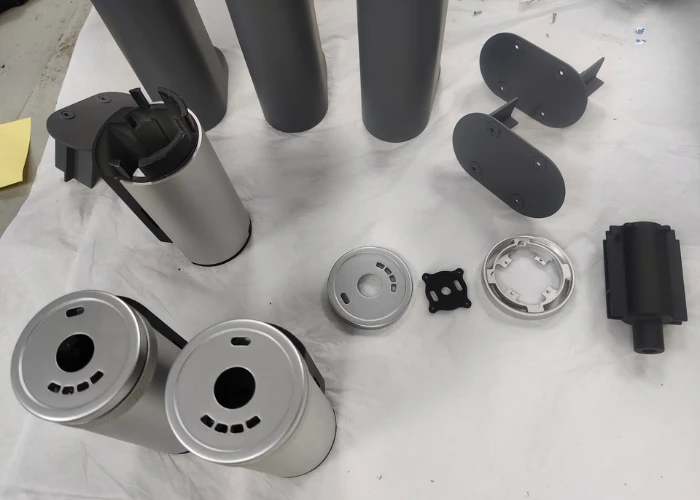
ABS is commonly selected for cosmetic prototypes because it supports a range of established finishing processes, including sanding, priming, painting, and decorative treatments when compatible systems are used. For a consumer electronics housing or beauty device prototype, these processes can help the development team evaluate color, gloss, texture, and the alignment of visible components. However, the surface finish depends on the machining quality, preparation method, coating system, and operator control. Selecting ABS does not guarantee a flawless painted surface without appropriate finishing work.
Rigid PVC can also be painted or decorated, but the process should be qualified for the selected grade and finish specification. Adhesion, chemical compatibility, and long-term coating behavior may differ from those of ABS. We therefore recommend confirming the intended cosmetic standard before selecting a material. If the prototype is primarily intended for appearance review and repeated customer demonstrations, ABS may offer a more familiar finishing route. If the prototype must also withstand a specific chemical environment, the coating and substrate should be evaluated as a combined system rather than separately.
Fasteners, Assembly Loads, and Repeated Handling
Assembly introduces localized stresses that may not be apparent when evaluating an isolated component. Screw holes, threaded features, locating pins, and thin connecting sections all experience forces during installation. ABS is often advantageous for frequently handled housings because its toughness can help tolerate incidental impacts and certain assembly stresses. Nevertheless, excessive tightening, insufficient edge distance, or poorly designed fastening features can still cause damage. Material toughness does not eliminate the need for sound mechanical design, especially when a prototype will be repeatedly assembled and disassembled during development.
Rigid PVC may be appropriate for stationary assemblies where stiffness or chemical resistance is the dominant requirement. However, the selected grade and local geometry must be reviewed carefully if fasteners introduce concentrated loads. We recommend identifying which interfaces are intended for repeated use and which will remain permanently assembled. This distinction helps engineers decide whether the prototype needs stronger fastening features, different connection methods, or a tougher material. For prototypes with several mating components, assembly performance should be considered alongside individual part properties rather than treated as a separate issue after manufacturing.
How Does PVC vs ABS Affect Prototype Cost and Development Efficiency?
Material price is only one component of CNC prototype cost. The final quotation also depends on stock availability, component size, machining complexity, finishing requirements, inspection, and assembly work. We compare PVC and ABS from the perspective of the complete development process because the cheapest raw material does not always produce the most economical prototype. A material that requires additional processing or causes a design revision may increase the total project cost.
Density provides one straightforward example. Typical rigid PVC has a density around 1.35–1.45 g/cm³, while general-purpose ABS is commonly around 1.02–1.08 g/cm³. If two parts have identical geometry and are made from representative grades, the PVC part will generally be heavier. This difference may influence material consumption by mass, shipping weight, and the handling characteristics of larger prototypes. However, it does not establish which material will cost more. Suppliers price different grades and stock forms differently, and machining cost may outweigh the raw material difference for complex components.
Finishing and assembly can create larger differences than the initial stock price. A painted ABS housing may follow a familiar finishing process, while a PVC component with demanding cosmetic requirements may need additional coating compatibility checks. Conversely, selecting ABS for a component that requires PVC-like chemical resistance could result in a prototype that cannot perform its intended evaluation. In that situation, the cost of remaking the part and repeating development work may exceed any initial savings. We therefore assess whether the material supports the purpose of the prototype before comparing quotations.
Development efficiency also depends on how much uncertainty the prototype can eliminate. A material choice that accurately represents the intended application can help engineers make useful design decisions after the first build. An inappropriate substitute may produce misleading conclusions and require another iteration. For purchasing teams, this means that material selection should be discussed together with project objectives, required quantities, finishing expectations, and delivery priorities. The best commercial decision is not necessarily the lowest unit price, but the option that provides reliable engineering information at a reasonable total cost.
When Should Engineers Choose PVC Instead of ABS?
PVC becomes a stronger candidate when the prototype’s primary requirements involve resistance to compatible chemicals, relatively high rigidity, or specific electrical insulation needs. These applications differ from conventional consumer-product housings, where impact resistance and cosmetic appearance often receive greater priority. We recommend selecting PVC only after confirming the actual exposure conditions and the suitability of the proposed material grade, rather than assuming that all rigid PVC products behave identically.
Consider an industrial fixture used to hold a component during a chemical cleaning process. The fixture may remain stationary for most of its service life but experience repeated contact with a cleaning solution. In this case, resistance to the chemical environment may be more important than impact toughness or decorative finishing. If the selected rigid PVC grade is compatible with the cleaning agent and operating temperature, it may offer a practical solution. ABS could still be machined into the same shape, but matching the geometry would not guarantee equivalent chemical performance.
Another example is a rigid insulating support inside industrial equipment. The engineer may need the component to maintain its position under a moderate static load while meeting specified electrical requirements. PVC could be considered because of its stiffness and insulating properties, provided the exact grade satisfies the electrical, thermal, and environmental specifications. However, the material should not be approved solely because PVC is commonly described as an electrical insulator. Relevant dielectric properties, operating voltage, required certifications, and safety factors must be verified for the intended application.
PVC should not be selected automatically when the component will experience repeated impacts, high temperatures, or uncertain chemical mixtures. Those conditions may reduce the relevance of its stiffness and chemical resistance advantages. We recommend treating PVC as an application-specific engineering option rather than a general replacement for ABS. The strongest material decision is supported by the actual exposure conditions and the required performance of the finished component.
When Is ABS the Better Choice for CNC Plastic Prototypes?
ABS is often the more practical starting point when a prototype must combine impact resistance, acceptable rigidity, assembly durability, and cosmetic finishing. These requirements frequently appear in consumer electronics, beauty devices, personal care appliances, and general equipment housings. However, choosing ABS should still be based on the component’s operating conditions and the purpose of the prototype. Its popularity does not make it suitable for every chemical, thermal, or structural environment.
Consider a handheld beauty device housing that will be displayed to customers and repeatedly assembled during development. Engineers may need to evaluate the external appearance, the alignment of mating surfaces, the position of buttons, and the strength of fastening features. ABS can be a suitable choice because it supports CNC machining and common cosmetic finishing methods while offering useful impact toughness. The prototype can provide information about appearance, fit, and handling, although additional validation may be needed for final-product durability and production-specific behavior.
ABS is also useful for equipment covers and instrument housings that may experience incidental knocks during installation or servicing. Its toughness can provide an advantage over standard rigid PVC when impact damage is a realistic concern. Nevertheless, ABS should not be selected without reviewing local heat exposure, cleaning chemicals, and fastening stresses. A housing installed close to a heat source or cleaned with an incompatible solvent may require a different ABS grade or an alternative engineering plastic.
For many appearance-oriented prototypes, ABS offers a balanced combination of manufacturing practicality and functional relevance. We generally favor it when the project focuses on housing development, visual presentation, and mechanical fit, provided the operating environment does not demand properties that ABS cannot deliver. This approach keeps material selection aligned with the prototype’s purpose rather than treating ABS as the default answer to every CNC plastic machining project.
How Should Engineers Finalize the PVC vs ABS Material Selection?
The final material decision should be based on the prototype’s intended function, the properties that must be validated, and the limitations of the selected stock grade. We recommend completing this review before releasing drawings for manufacturing because late material changes can affect geometry, fastening details, surface finishing, and the interpretation of prototype results. A structured decision process also helps purchasing and engineering teams communicate more effectively with their manufacturing supplier.
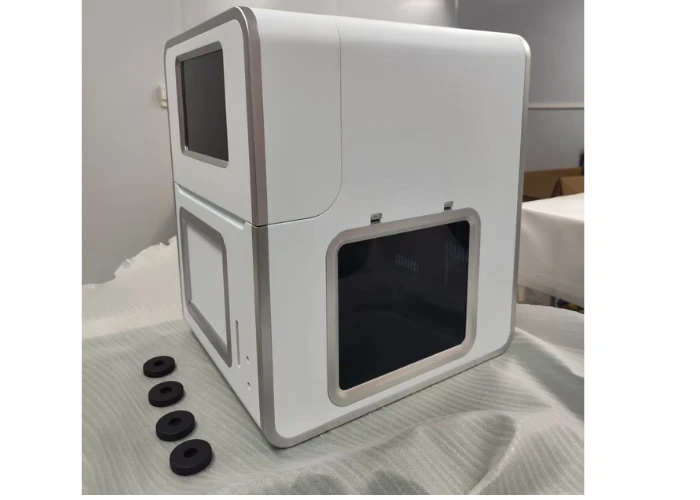
We begin by identifying the prototype’s primary purpose. A model intended for visual presentation may place greater importance on surface finish and appearance, while an assembly prototype may prioritize fit, fastening, and handling. A functional component exposed to chemicals or sustained loading requires a different level of material evaluation. Defining the purpose helps us distinguish properties that must be reproduced accurately from those that can be approximated during early development. This prevents unnecessary manufacturing requirements from being applied to features that are not central to the current design decision.
Next, we review the application conditions and material documentation. The required information may include operating temperature, chemical exposure, mechanical loads, target appearance, critical interfaces, and any applicable regulatory or certification requirements. When these conditions are known, the engineering team can compare the relevant PVC and ABS grades instead of relying on generic material descriptions. We also recommend confirming whether the chosen stock is available in the dimensions needed for CNC machining. Material availability can influence both quotation accuracy and the practicality of the proposed manufacturing approach.
As a China-based direct plastic prototype manufacturer, UForProto provides CNC plastic machining services, surface finishing, and prototype assembly for engineering plastic components. ABS is one of our established machining materials. For PVC-specific projects, material availability and processing suitability should be confirmed during technical review before we commit to a manufacturing plan. Engineers and purchasing teams can send CAD files, material requirements, and project details to info@uforproto.com for feasibility evaluation and quotation.
Conclusion
Choosing between PVC vs ABS for CNC prototyping requires balancing material properties with the intended application. Rigid PVC generally offers advantages in stiffness and resistance to compatible chemicals, while ABS is often preferable for impact-resistant housings, cosmetic prototypes, and frequently handled components.
Both materials can be CNC machined, but machining suitability alone does not determine whether a prototype will perform as intended. Engineers should also consider temperature, chemical exposure, assembly requirements, material grade, and the purpose of validation.
By evaluating these factors together, development teams can make more reliable material decisions, reduce unnecessary prototype revisions, and obtain more useful engineering results.
FAQs
The following questions address common material-selection concerns when engineers compare PVC and ABS for machined plastic prototypes.
1. Is PVC Stronger Than ABS?
Rigid PVC is generally stiffer than standard ABS, but ABS typically offers better impact resistance. Which material is stronger depends on whether the component experiences static loading, bending, or sudden impact. We recommend comparing grade-specific mechanical properties against the actual loading conditions rather than relying on a single strength value.
2. Is PVC or ABS Easier to CNC Machine?
Both rigid PVC and ABS can be CNC machined successfully. ABS is widely available in machining-grade stock and is commonly used for housings and general-purpose prototypes. PVC also offers good machinability, but the selected grade and component geometry require evaluation. Neither material guarantees a specific tolerance without appropriate manufacturing control.
3. Which Is Better for CNC-Machined Plastic Housings?
ABS is often preferred for consumer electronics and equipment housings because of its impact toughness and compatibility with common cosmetic finishing processes. Rigid PVC may be more suitable for selected industrial housings requiring chemical resistance or stiffness. The final decision should consider handling, operating temperature, and assembly requirements.
4. Is PVC More Chemical-Resistant Than ABS?
Rigid PVC generally resists many compatible acids, alkalis, and aqueous chemicals better than standard ABS. However, chemical compatibility varies with concentration, temperature, exposure duration, and material grade. We recommend consulting supplier chemical-resistance data before selecting either plastic for laboratory, cleaning, or fluid-contact applications.
5. Is PVC Cheaper Than ABS for CNC Prototypes?
Not necessarily. Material cost depends on grade, stock dimensions, supplier availability, and quantity. Total prototype cost also includes machining, finishing, inspection, and potential revisions. We recommend comparing the complete project cost and the material’s suitability for the intended evaluation rather than selecting the lowest-priced raw material.
6. Can ABS Replace PVC in a Functional Prototype?
ABS may substitute for PVC when the prototype is used mainly to evaluate geometry, assembly fit, or appearance. However, it should not be treated as an equivalent replacement when chemical resistance, stiffness, or other material-dependent properties are essential. Any substitution should be documented, and the resulting validation limits should be understood.