
What temp does plastic melt? There is no single temperature that applies to every plastic. Different polymers respond to heat according to their molecular structure and crystallinity. Semi-crystalline plastics such as PP, POM, nylon, and PE have measurable melting temperatures, while amorphous plastics such as ABS, PC, and PMMA soften gradually instead of melting at one sharp temperature. In this guide, I explain the thermal behavior of 12 common plastics and what these temperatures mean when engineers select materials for plastic parts and prototypes.
What Temp Does Plastic Melt?
When engineers ask what temp does plastic melt, I first need to know which plastic they mean. Common thermoplastics cover a wide thermal range. LDPE may melt around 105–115°C, PP around 160–170°C, PA66 around 255–262°C, and PEEK around 343°C. ABS, PC, and PMMA behave differently because they do not have the same sharp crystalline melting point.
Plastic is not one material. It is a broad family of polymer-based materials with different molecular structures, levels of crystallinity, additives, fillers, reinforcement, and commercial grades. These differences determine how each plastic responds when temperature increases.
This is why saying “plastic melts at 170°C” is technically misleading. That number may be relevant to some polypropylene grades, but it cannot be applied to polyethylene, nylon, POM, PPS, PEEK, ABS, PC, or PMMA.
For semi-crystalline thermoplastics, I can normally identify a melting temperature or melting range, known as Tm. At this stage, the ordered crystalline regions lose their structure as the polymer moves toward the molten state.
Amorphous plastics require a different interpretation. ABS, PC, and PMMA do not contain the same organized crystalline structure, so they progressively soften as molecular mobility increases rather than reaching one clearly defined crystalline melting point.
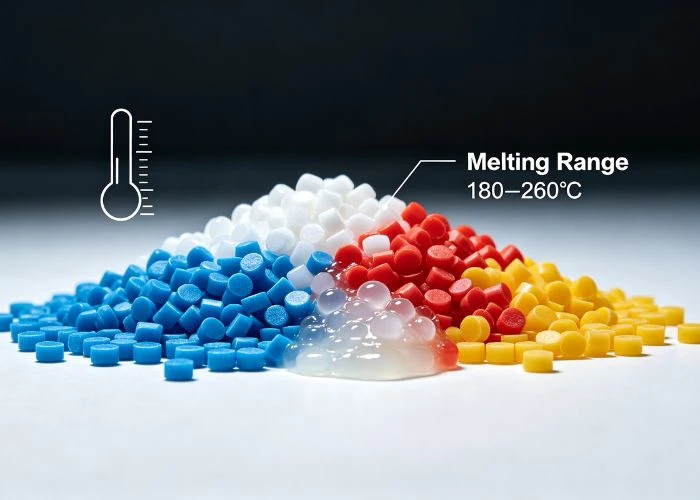
Plastic Melting Point Chart for 12 Common Plastics
A plastic melting point chart is useful only when the temperatures are correctly identified. I therefore separate semi-crystalline plastics with a measurable Tm from amorphous plastics that are better described by glass transition and progressive softening. These are typical reference values rather than guaranteed specifications, and the selected material grade should always be checked before an engineering decision.
| Plastic | Structure | Thermal Behavior | Typical Temperature | °F | Engineering Note |
| LDPE | Semi-crystalline | Melting / Tm | 105–115°C | 221–239°F | Relatively low melting range |
| HDPE | Semi-crystalline | Melting / Tm | 120–140°C | 248–284°F | Grade and crystallinity matter |
| PP | Semi-crystalline | Melting / Tm | 160–170°C | 320–338°F | ≈165°C is a common reference |
| POM | Semi-crystalline | Melting / Tm | 160–175°C | 320–347°F | Homopolymer and copolymer differ |
| PA6 | Semi-crystalline | Melting / Tm | 220–235°C | 428–455°F | Moisture also affects behavior |
| PA66 | Semi-crystalline | Melting / Tm | 255–262°C | 491–504°F | Higher Tm than PA6 |
| PET | Semi-crystalline | Melting / Tm | 245–260°C | 473–500°F | Crystallinity matters |
| PPS | Semi-crystalline | Melting / Tm | 280–285°C | 536–545°F | High-temperature engineering plastic |
| PEEK | Semi-crystalline | Melting / Tm | ≈343°C | ≈649°F | High-performance polymer |
| ABS | Amorphous | Tg / Softening | ≈100–105°C Tg | ≈212–221°F | No sharp crystalline Tm |
| PMMA | Amorphous | Tg / Softening | ≈105°C Tg | ≈221°F | Gradual softening |
| PC | Amorphous | Tg / Softening | ≈145–150°C Tg | ≈293–302°F | No sharp crystalline Tm |
This table immediately explains why what temp does plastic melt cannot have one numerical answer. LDPE and PEEK differ by more than 200°C in melting temperature, while ABS and PC cannot even be compared with PP using exactly the same thermal property.
I also would not use these values as guaranteed limits for finished parts. A commercial plastic may contain impact modifiers, glass fibers, flame retardants, lubricants, stabilizers, or other additives that alter its thermal and mechanical behavior.
For an engineering project, I use a general chart to understand the material family, then verify the actual grade against the material supplier’s technical datasheet.
Why Do Different Plastics Melt at Different Temperatures?
Different plastics respond differently to heat because their polymer chains are organized and bonded differently. Molecular structure, intermolecular attraction, crystallinity, molecular weight, and formulation all influence thermal behavior. For engineers, the most useful first distinction is whether a plastic is semi-crystalline or amorphous because this determines whether a conventional melting point is the right property to use.
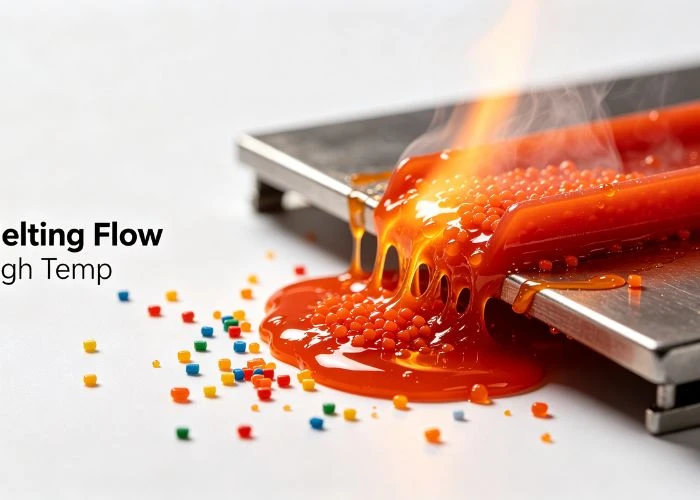
Semi-Crystalline Plastics Have a Characteristic Melting Temperature
Semi-crystalline thermoplastics contain both crystalline and amorphous regions within their polymer structure. The crystalline regions have a more ordered molecular arrangement, while the amorphous regions remain less ordered. As temperature increases, the crystalline phase eventually loses its ordered structure, producing a measurable melting transition commonly described by the melting temperature, or Tm.
Unlike amorphous plastics, semi-crystalline materials therefore have a characteristic melting temperature or melting range associated with the crystalline phase. This does not mean the entire polymer changes from a rigid solid to a freely flowing liquid at one exact temperature. The observed transition normally occurs over a range, and its behavior depends on the polymer and material grade.
PP, PE, POM, PA6, PA66, PET, PPS, and PEEK are common semi-crystalline thermoplastics. Their melting temperatures differ significantly because polymer chemistry, molecular structure, and crystalline organization determine how much thermal energy is required to disrupt the crystalline phase.
For example, PP typically has a melting range around 160–170°C, PA66 around 255–265°C, PPS around 280–290°C, while PEEK has a characteristic melting temperature of approximately 343°C. These differences show why a single “plastic melting temperature” cannot represent the thermal behavior of all thermoplastics.
The published Tm should still be treated as a material-specific reference rather than a universal constant. Polymer grade, degree of crystallinity, copolymer composition, fillers or reinforcement, and previous thermal processing can influence the measured melting range and the way the material responds as it approaches that range. For an engineering project, I therefore verify the thermal data for the actual material grade rather than relying only on a generic value for the polymer family.
Amorphous Plastics Do Not Have a Distinct Crystalline Melting Point
Amorphous thermoplastics behave differently from semi-crystalline plastics because their polymer chains do not form the same ordered crystalline regions. As a result, they do not exhibit a distinct crystalline melting temperature, or Tm. Instead, their thermal behavior is more appropriately described by the glass transition temperature (Tg) and the progressive changes in mechanical properties that occur as temperature continues to rise.
Below Tg, an amorphous plastic is generally in a relatively rigid, glassy state. As the material passes through its glass-transition region, molecular chain mobility increases and its modulus and stiffness decrease. With further heating, the material becomes progressively softer and can eventually reach a viscous flow state, but this transition does not occur at one sharply defined melting temperature.
ABS, PMMA, and PC are common amorphous engineering plastics. When I evaluate their thermal behavior for a prototype part, I therefore distinguish Tg from softening temperature, processing temperature, and actual service temperature rather than treating these values as interchangeable with a conventional melting point.
ABS provides a useful example. Its glass transition temperature is commonly around 100–105°C, depending on the grade and test conditions. This range indicates a significant change in molecular mobility and mechanical response; it does not represent a crystalline melting point comparable with the Tm of a semi-crystalline plastic such as PP. For engineering decisions, identifying the thermal property behind the reported temperature is therefore more important than simply asking for a single “ABS melting point.”
Melting Point vs Glass Transition Temperature: What Is the Difference?
Melting point and glass transition temperature describe different changes inside a polymer. I separate them because treating Tg as another name for Tm can produce incorrect material comparisons. Tm describes the breakdown of crystalline order, while Tg marks a major change in molecular mobility within amorphous regions. Neither should automatically be interpreted as the safe operating temperature of a finished part.
Comparison Table
| Factor | Melting Point (Tm) | Glass Transition Temperature (Tg) |
| Main physical change | Crystalline structure loses order | Molecular mobility increases |
| Most relevant to | Semi-crystalline materials | Amorphous regions/materials |
| Transition behavior | More clearly defined | Occurs over a region |
| Examples | PP, POM, PA, PPS, PEEK | ABS, PMMA, PC |
| Does it instantly become liquid? | No | No |
| Is it the maximum service temperature? | No | No |
A semi-crystalline polymer can have both Tg and Tm because its structure contains both amorphous and crystalline regions. PEEK, for example, has a Tg around 143°C and a Tm around 343°C. These values represent different transitions rather than conflicting data.
For an amorphous plastic such as PMMA or PC, Tg often tells me more about when stiffness and dimensional behavior begin changing significantly than a supposed conventional melting point.
This distinction also explains why online charts sometimes provide conflicting numbers. Some tables label Tg, softening temperature, or even processing temperature as a “melting point,” even though these properties answer different engineering questions.
Does Plastic Start to Deform Before It Melts?
Yes. This is one of the most important engineering points behind the question what temp does plastic melt. A plastic component can lose stiffness, expand, creep, or change dimensions well before it reaches Tm. I therefore never treat melting point alone as the maximum operating temperature of a functional plastic part.
PP is a simple example. Its melting point is commonly around 160–170°C, but this does not mean a loaded PP component will maintain its original stiffness and dimensions until 160°C.
As temperature rises, polymer chains gain mobility. Stiffness can decrease, thermal expansion changes dimensions, and sustained mechanical load can produce increasing creep.
For a decorative cover, a small dimensional change may have limited functional impact. For a precision locating feature, bearing seat, gear, mating interface, or internal support, however, the same thermal change can directly affect whether the part performs as intended.
This is why engineering material selection may also require consideration of Tg, heat deflection temperature, continuous service temperature, thermal expansion, mechanical load, environmental exposure, and the exact material grade. A plastic part can therefore experience meaningful changes in stiffness, dimensions, or mechanical performance well before the material reaches its melting temperature.
Is Plastic Melting Point the Same as Processing Temperature?
No. Melting point describes a thermal transition within a polymer, while processing temperature describes the conditions used to shape or manufacture that polymer in a specific process. The values may be related, but they should not be used interchangeably. This distinction is especially important when engineers compare material datasheets or research how a particular plastic is manufactured.
For a semi-crystalline thermoplastic, a melt-processing operation generally needs the material above its melting region before it can flow effectively. The required processing window depends on the polymer, viscosity, grade, equipment, and manufacturing method.
For an amorphous plastic, there is no equivalent sharp Tm. Instead, the material progressively softens above Tg until it reaches the flow behavior required by the manufacturing process. Recent engineering temperature guides therefore list Tg, Tm, and processing range as separate properties.
I also separate both values from service temperature. A polymer may be processable at a high temperature but unable to maintain the required stiffness, dimensions, or mechanical performance at anything close to that temperature during actual use.
Which Plastics Melt at Lower and Higher Temperatures?
Comparing melting ranges gives engineers a useful overview of how different polymer families respond to heat. However, I only rank materials that have a meaningful Tm. ABS, PC, and PMMA should not be placed into the same low-to-high melting-point ranking because their amorphous structure produces a different type of thermal transition.
LDPE sits near the lower end of the materials in our chart at approximately 105–115°C. HDPE generally melts at a somewhat higher temperature, typically around 120–140°C.
PP and POM occupy another range around 160–175°C. Their melting temperatures may overlap, but this does not mean they are interchangeable materials. Their stiffness, friction, moisture response, chemical resistance, and manufacturing behavior are different.
Nylon moves higher. PA6 is typically around 220–235°C, while PA66 reaches approximately 255–262°C. This difference is one reason why writing only “nylon” on an engineering requirement can be insufficient.
At the higher end, PPS is around 280–285°C and PEEK approximately 343°C. These materials can support more demanding thermal environments, but their higher Tm does not automatically make them the best choice for every application.
Material selection must still balance thermal requirements with mechanical performance, dimensional stability, environmental exposure, manufacturability, availability, and cost.
Why Does Plastic Melting Temperature Matter for Prototype Parts?
In prototype development, I treat melting temperature as useful material information rather than a complete selection rule. What matters more is whether temperature can change the property the prototype is intended to evaluate. A prototype may need to validate appearance, dimensions, mechanical behavior, interfaces, or assembly, and each objective creates a different reason to consider thermal behavior.
For an appearance prototype used to evaluate overall shape, color, texture, and visual presentation, melting point may have relatively little influence on the development decision.
A functional prototype operating around heat is different. The engineering team may need a dimension to remain stable, a support to carry load, or two mating parts to maintain their intended relationship as temperature changes.
This is particularly important in plastic prototyping because the selected material should help answer the actual development question. A visually similar substitute may reproduce geometry but give a misleading result when the team evaluates heat, stiffness, friction, or dimensional behavior.
When actual engineering-plastic behavior matters, CNC plastic machining can provide prototypes machined directly from specified plastic stock. This allows the physical prototype to represent the selected material more closely than a substitute that only resembles it visually.
However, melting point remains only one property. Grade, reinforcement, moisture, geometry, wall thickness, mechanical load, and operating conditions may all influence the final prototype behavior.
Can Plastic Melting During CNC Machining?
Localized softening or melting can occur during CNC plastic machining when cutting heat becomes concentrated near the tool and workpiece. This does not make CNC machining a thermal forming process; material is still removed mechanically. However, plastics generally dissipate heat more slowly than metals and have lower softening temperatures, so localized overheating can affect the machined surface and final dimensions.
Mitsubishi Chemical notes that plastics can have thermal expansion substantially greater than metals, lose heat more slowly, and have much lower softening and melting temperatures. These characteristics help explain why temperature management matters when machining engineering plastics.
How We Consider Plastic Temperature During Prototype Manufacturing
When I review a prototype project, I do not make a manufacturing decision from melting point alone. I look at the actual material grade, prototype purpose, part geometry, wall thickness, critical dimensions, operating environment, surface requirements, and assembly relationships. These factors help determine whether the selected plastic and manufacturing route can provide useful engineering evidence.
At UForProto, we are a direct plastic prototype manufacturer, not a trading company. We support engineering, R&D, and purchasing teams with plastic prototyping, CNC plastic machining, SLA and SLS 3D printing, vacuum casting, surface finishing, and complete prototype assembly.
For CNC projects, we commonly work with engineering plastics such as ABS, PMMA, PC, PP, POM, PA66, PPS, PE, and other project-specific materials.
These materials do not respond identically during manufacturing. Soft and flexible PP behaves differently from rigid PMMA; PC behaves differently from POM; and nylon introduces additional considerations because moisture can influence dimensions. Plastic machining guidance similarly emphasizes thermal expansion, elasticity, heat retention, moisture, and internal stress rather than melting point alone.
When engineers send us a project, I prefer to review the CAD together with drawings, material requirements, critical dimensions, quantity, surface finish, and relevant assembly information.
This gives us a much stronger basis for reviewing manufacturability than simply knowing the name or melting temperature of the plastic.
Conclusion
What temp does plastic melt? The answer depends on the polymer rather than one universal temperature. Semi-crystalline plastics such as PP, POM, nylon, PPS, and PEEK have measurable melting temperatures, while amorphous plastics such as ABS, PMMA, and PC soften progressively around their glass-transition regions. More importantly, a plastic part can lose stiffness or dimensional stability before it melts, so Tm should never be used alone as a service-temperature limit. For plastic prototyping or CNC plastic machining projects, engineers and purchasing teams can send UForProto CAD files, drawings, materials, quantities, and critical requirements for manufacturing review and quotation.
FAQs
1. What Temp Does Plastic Melt?
There is no universal plastic melting temperature. LDPE typically melts around 105–115°C, PP around 160–170°C, PA66 around 255–262°C, and PEEK around 343°C. ABS, PC, and PMMA are amorphous, so they do not have the same type of sharp crystalline melting point.
2. What Plastic Has the Lowest Melting Point?
Among the common thermoplastics covered here, LDPE has one of the lower melting ranges at approximately 105–115°C. HDPE is generally higher at around 120–140°C. Exact values depend on grade, density, crystallinity, additives, and supplier formulation.
3. What Temperature Does PP Plastic Melt?
Polypropylene typically melts around 160–170°C (320–338°F), with approximately 165°C commonly used as a reference. The exact temperature depends on PP type, grade, crystallinity, and additives, so I recommend checking the technical datasheet for the actual material selected.
4. What Temperature Does ABS Plastic Melt?
ABS does not have one sharp crystalline melting point because it is an amorphous thermoplastic. Its glass-transition region is commonly around 100–105°C, after which it progressively softens as temperature increases. Calling 105°C simply the “ABS melting point” therefore gives an incomplete engineering picture.
5. Does Plastic Soften Before It Melts?
Yes. Plastic can lose stiffness, expand, creep, or deform before reaching its melting temperature. Engineers should therefore consider Tg, heat-deflection behavior, service temperature, thermal expansion, mechanical load, and the actual material grade rather than relying only on Tm.
6. Can Plastic Melting During CNC Machining?
Localized softening or melting can occur when cutting and friction generate heat faster than the plastic can dissipate it. This can affect surface quality and dimensions without the entire workpiece melting. We will examine the causes and heat-control strategies separately in our CNC-focused article.