
Plastic melting during CNC machining usually begins as a localized heat problem rather than the entire workpiece reaching its published melting temperature. In our machining work, excessive heat may appear as smeared surfaces, heavy burrs, welded chips, distorted edges, or unstable dimensions after cooling. Because engineering plastics respond to heat differently from metals, preventing these problems requires more than simply lowering spindle speed. I need to consider how the tool cuts, how chips leave the cutting zone, how heat is removed, and how the specific plastic responds to temperature.
Why Does Plastic Melting During CNC Machining Occur?
CNC machining is a material-removal process, but every cut also generates heat. With plastic, that heat becomes particularly important because many engineering polymers conduct heat slowly and have much lower softening or melting temperatures than metals. The real manufacturing issue is therefore not only how much heat is generated, but also where that heat goes.
During an efficient cut, part of the generated heat leaves the cutting zone with the chip. When the cutting edge rubs instead of shearing cleanly, or when hot chips remain trapped around the tool, more heat stays close to the workpiece. The temperature immediately around the cutting edge can then become much higher than the temperature of the rest of the part.
This explains why a plastic part can show thermal damage even though the complete workpiece has never approached its nominal melting temperature. Mitsubishi Chemical notes that plastics can lose heat more slowly than metals and have substantially lower softening and melting temperatures, increasing the importance of thermal control during machining.
If you first need to understand the difference between melting temperature, glass transition, and softening behavior for common plastics, our guide to what temp does plastic melt explains those material-level thermal properties in more detail.
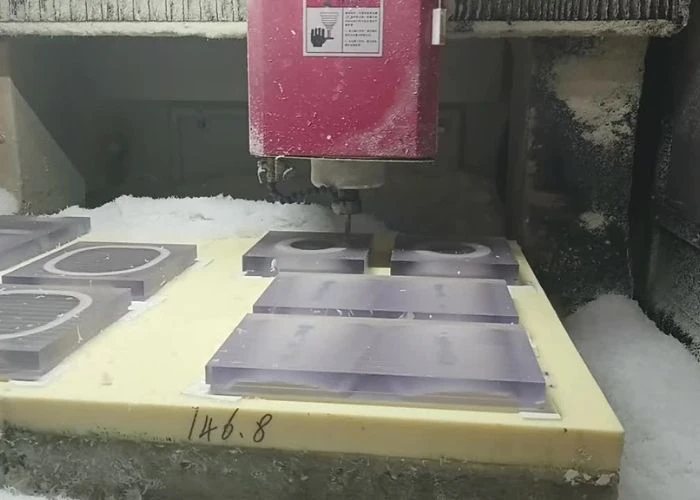
How Can I Recognize Heat Damage During CNC Plastic Machining?
Plastic melting during CNC machining does not always look like liquid plastic. In many prototype parts, the first signs are much less dramatic. I usually evaluate the machined edge, surface condition, chip behavior, and dimensional response together because a single symptom does not always prove that excessive heat is the root cause.
Melted Edges and Surface Smearing Can Indicate Local Softening
When a cutting edge removes plastic cleanly, I expect a defined machined surface and chips that separate from the workpiece. If the material becomes too warm around the tool, the cutting behavior can change. Instead of separating cleanly, softened plastic may stretch, smear across the surface, form heavier burrs, or adhere again near the cutting edge.
I do not automatically treat every burr as a heat problem. Burr formation can also be affected by material ductility, tool condition, cutting geometry, and support. Heat becomes a stronger suspect when smearing, welded chips, softened edges, or other thermal symptoms appear at the same time.
Dimensional Change May Appear After the Part Cools
Heat can affect more than the visible surface. Engineering plastics generally expand more with temperature than metals, so a dimension measured while the part is still warm may not represent its stabilized dimension. This becomes important when machining locating features, holes, mating surfaces, or other geometry that influences fit.
For this reason, I separate visible heat damage from thermal dimensional change. A surface can look acceptable while the part is still responding to machining temperature. For critical prototype dimensions, the final judgment should be based on the stabilized part rather than only on an immediate in-process measurement.
Where Does Excessive Heat Come From During CNC Plastic Machining?
When I investigate plastic melting during CNC machining, I do not begin by blaming the material. Excessive heat often develops because the cutting process is no longer removing material efficiently. Tool condition and chip evacuation are two of the first areas I review because both directly influence friction and the amount of heat retained around the cutting zone.
A Dull Tool Generates More Rubbing and Heat
A sharp cutting edge helps shear the plastic and create a controlled chip. As the edge becomes dull, more of the tool can rub or push against the material instead of cutting efficiently. This increases friction, raises the local temperature, and can make a previously stable machining process begin producing poorer edges or surfaces.
Tool condition therefore becomes part of thermal control. Curbell recommends correctly sharpened tools for plastic machining, while reinforced plastics can require more wear-resistant tooling. In practice, I consider the plastic grade, tool material, cutting-edge condition, and the surface being produced together rather than treating tool replacement as a fixed interval.
Poor Chip Evacuation Keeps Heat Near the Workpiece
Chips are not simply waste produced by CNC plastic machining. They are also one of the paths through which heat leaves the cutting zone. When chips clear efficiently, they carry part of the generated heat away. When they remain in a pocket, wrap around the tool, or are repeatedly cut again, heat and friction can increase around the same area.
This is especially important in holes, narrow slots, and deeper enclosed features where the chip has fewer paths to escape. Curbell specifically identifies poor chip ejection as a cause of frictional heat buildup during plastic drilling. I therefore treat chip evacuation as a machining-control issue, not merely a housekeeping issue.
Why Must Spindle Speed and Feed Be Balanced?
A common response to plastic melting during CNC machining is simply to reduce spindle speed. I do not consider that a complete solution. Heat generation depends on the relationship between spindle speed, feed, tool geometry, cutting depth, chip formation, and the specific plastic being machined. Changing one value without considering the others can create a different machining problem.
If spindle speed is high while feed is too light for the tool and operation, the cutting edge may spend more time rubbing the plastic without forming an effective chip. That additional friction can raise the local temperature. A more productive adjustment is to restore efficient cutting so that the edge shears material and chips leave the cutting zone consistently.
Increasing feed without considering the part is not the answer either. Excessive cutting force can affect flexible features, surface quality, and part stability. I therefore establish cutting conditions around the actual material, tool diameter, geometry, depth of cut, and feature being machined instead of applying one universal RPM recommendation to every plastic.
How Can Better Chip Control Reduce Plastic Melting During CNC Machining?
Once the cutting edge is working correctly, I want the resulting chips to leave the machining area quickly. Effective chip control reduces recutting, limits heat accumulation around the tool, and helps maintain a more consistent cutting condition. This becomes increasingly important as the tool moves into deeper or less open geometry.
For open milling, tool geometry and the available space around the cut can allow chips to escape relatively easily. In a deep pocket or narrow slot, I may need to consider toolpath, cutting sequence, chip clearance, and air assistance together. The solution should maintain a clean cutting zone rather than allowing hot chips to circulate around the cutter.
Different plastics also produce different chip behavior. A ductile plastic that generates long continuous chips requires a different approach from a material that breaks into shorter chips. For this reason, I adjust chip control according to actual machining behavior instead of assuming that one evacuation method will work equally well for every engineering plastic.

Does Cooling Always Prevent Plastic Melting During CNC Machining?
Cooling can help control localized heat, but I do not use it as a substitute for correct cutting. If the tool is dull, the cutting edge is rubbing, or chips remain trapped around the cutter, adding more coolant may reduce temperature without correcting the process that created excessive heat in the first place.
Air and Cutting Fluids Solve Different Thermal Problems
Clean compressed air can perform two useful functions: it helps move chips away from the cutter and can reduce localized heat. This makes it useful when chip evacuation is part of the thermal problem. A compatible water-based coolant may provide additional temperature control where surface finish, drilling, or close dimensional requirements justify it.
However, coolant selection cannot be separated from material compatibility. Boedeker notes that general-purpose petroleum-based cutting fluids can contribute to stress cracking in amorphous plastics including acrylic and polycarbonate. I therefore select cooling according to the material and operation instead of assuming that a coolant suitable for metal machining is automatically suitable for plastic.
Why Are Drilling and Deep Features More Sensitive to Heat?
Heat becomes harder to manage when the cutting zone is enclosed. Drilling is a good example because the cutting edges operate inside the material while chips must travel out through limited space. Curbell notes that drilling generates more heat than most other plastic machining operations, making heat reduction and chip clearance especially important.
For deeper holes, continuously pushing the drill farther into the material can allow chips and heat to accumulate around the cutting edges. Intermittent withdrawal, where appropriate, gives chips a path out and allows heat to leave the hole more effectively. The objective is not simply to slow the operation but to keep the cutting zone clear and thermally controlled.
The same reasoning applies to deep pockets and narrow internal features. As access becomes more restricted, I pay more attention to chip movement and local heat accumulation. This allows the machining strategy to respond to the geometry rather than treating every surface of the part as thermally equivalent.
Why Do Different Plastics Respond Differently to CNC Machining Heat?
The same machining conditions can produce very different results in different polymers. I therefore do not judge plastic melting during CNC machining from melting temperature alone. Thermal expansion, stiffness, thermal conductivity, softening behavior, moisture response, reinforcement, and chip characteristics can all change how a material behaves around the cutting edge.
PP and PE, for example, can be relatively flexible and can produce continuous chips, so I pay attention to clean cutting, chip control, and dimensional response. POM generally machines well, but local heating and thermal expansion can still matter when the part contains precision features. Nylon adds another variable because moisture can also influence its dimensions.
With PMMA and PC, surface condition can be especially important, and inappropriate heat or cutting-fluid selection can create additional risks. Reinforced PPS and other high-performance grades may tolerate higher service temperatures, but reinforcement can increase tool wear. A higher material temperature rating therefore does not remove the need for controlled CNC plastic machining.
How Does Part Geometry Change the Risk of Heat Damage?
Material properties are only part of the thermal problem. I can machine two parts from the same plastic stock and still need different heat-control strategies because their geometry changes cutting access, chip evacuation, local rigidity, and the amount of material available to absorb and distribute heat.
Thin ribs, small bosses, narrow slots, deep pockets, and small internal features can respond differently from a thick open section. I therefore review where heat is likely to concentrate before selecting the machining sequence. For a thin feature, however, heat is only one part of the manufacturing problem; cutting force and support can be equally important.
This distinction helps me avoid using a heat-control solution to solve what is actually a rigidity or support problem. For thin and flexible geometry, those mechanical factors should be evaluated together with temperature rather than forcing every defect into the category of plastic melting.
How Can Heat Affect CNC Plastic Machining Tolerances?
Not every thermal problem leaves a visibly melted surface. In precision CNC plastic machining, temperature can affect dimensions before obvious surface damage appears. Plastics generally have higher thermal expansion than metals, so the temperature at which a critical dimension is machined or inspected can influence the measured result.
For a non-critical cover, a small temporary dimensional change may have limited functional impact. For a bearing seat, locating feature, mating interface, or precision hole, the same thermal movement can influence fit. I therefore consider whether a critical dimension should be evaluated only after the part has returned to a more stable temperature.
This article does not require every tolerance to become tighter. The practical objective is to prevent machining temperature from creating a false impression of dimensional accuracy and to keep thermal effects from becoming an uncontrolled source of variation in the finished prototype.
How We Prevent Plastic Melting During CNC Machining
At UForProto, I treat heat control as part of the machining strategy rather than as a correction applied after a surface has already been damaged. As a direct plastic prototype manufacturer, we review the material, geometry, critical features, surface requirements, and machining access before deciding how a part should be cut.
We Control Heat From the Cutting Process, Not Only With Cooling
My first objective is to create an efficient cut. That means selecting an appropriate tool, maintaining a usable cutting edge, matching the cutting conditions to the material and feature, and giving chips a reliable path out of the cutting zone. Cooling is then applied where it adds value rather than being used to compensate for an unstable cutting process.
This approach is particularly important in plastic prototyping, where one project may include cosmetic housings, functional internal components, transparent parts, and precision mating features. The acceptable thermal response is not identical for all of them, so I adjust the machining strategy around what the prototype actually needs to demonstrate.
We Evaluate Critical Dimensions After the Part Has Stabilized
For dimensions that affect fit or function, I do not want machining heat to hide the actual condition of the finished part. Where the material, geometry, and tolerance require it, I allow the part to return toward a stable thermal condition before final dimensional verification rather than relying only on measurements taken immediately after cutting.
Our work covers CNC plastic machining together with vacuum casting, SLA/SLS 3D printing, surface finishing, and complete prototype assembly. Engineers, R&D teams, and purchasing teams can send us CAD files, specified materials, quantities, critical dimensions, and surface requirements so that I can review the manufacturing requirements before quotation.
Conclusion
Plastic melting during CNC machining is usually a localized thermal-control problem rather than the entire part reaching its melting point. I prevent heat damage by looking at the complete cutting condition: tool sharpness, effective chip formation, chip evacuation, appropriate speed and feed, cooling compatibility, part geometry, and dimensional stabilization. Lowering spindle speed alone does not solve every problem. A stable process must remove material efficiently while also giving heat a path away from the cutting zone. For CNC plastic machining projects, customers can send UForProto CAD files, material requirements, quantities, and critical dimensions for manufacturing review and quotation.
FAQs
1. Why Does Plastic Melt During CNC Machining?
Plastic melting during CNC machining usually occurs when frictional and cutting heat accumulates faster than it can leave the cutting zone. Dull tools, rubbing, poor chip evacuation, unsuitable cutting conditions, and enclosed features can all contribute. The complete workpiece does not need to reach its published melting temperature for local softening or thermal damage to occur.
2. Does High Spindle Speed Cause Plastic to Melt?
It can contribute, but spindle speed alone does not determine whether plastic overheats. I evaluate speed together with feed, tool geometry, tool diameter, cutting depth, chip formation, and material behavior. A high speed combined with ineffective cutting or excessive rubbing can generate heat, but simply lowering RPM is not a universal solution.
3. How Do You Prevent Plastic From Melting During CNC Machining?
I focus first on producing an efficient cut with a sharp and suitable tool. Cutting conditions should support proper chip formation, while chips need a clear path away from the tool. Depending on the material and operation, compressed air or a compatible coolant can provide additional heat control. The correct combination depends on the plastic grade and part geometry.
4. Why Do Plastic Chips Melt Back Onto the Machined Surface?
Hot chips can remain close to the cutter when evacuation is poor. If they contact the workpiece again while the local material is warm, they may smear or adhere to the machined surface. I address this by reviewing chip formation, tool geometry, cutting conditions, and evacuation rather than treating the adhered material only as a finishing defect.
5. Should Coolant Be Used When CNC Machining Plastic?
Not always. Many plastic machining operations can be performed without liquid coolant, while compressed air can assist both cooling and chip removal. Drilling, close-tolerance work, or certain materials may benefit from additional cooling. I also check chemical compatibility because some cutting fluids can contribute to stress cracking in amorphous plastics such as PMMA and PC.
6. Which Plastics Are Most Sensitive to CNC Machining Heat?
There is no useful universal ranking based only on melting temperature. I also consider softening behavior, thermal expansion, thermal conductivity, stiffness, moisture response, reinforcement, chip behavior, and the geometry being machined. PP, PE, PMMA, PC, POM, nylon, PPS, and other engineering plastics therefore require material-specific machining decisions rather than one heat-control rule.