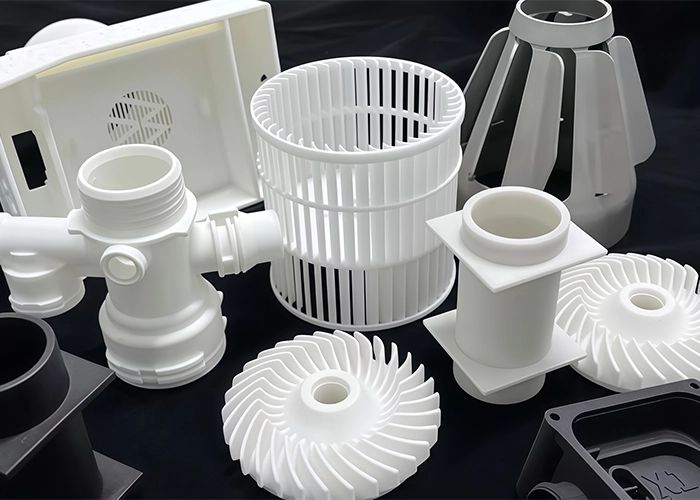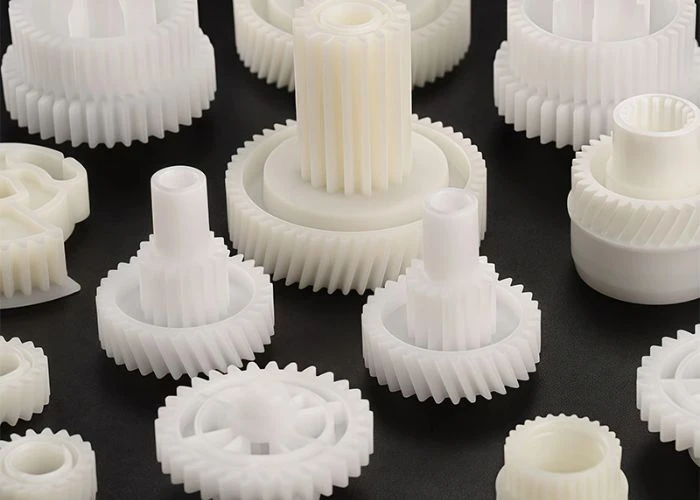

Plastic 3D printing materials determine much more than the appearance of a printed part. They influence stiffness, toughness, flexibility, heat response, surface quality, dimensional behavior, and what an engineer can realistically validate with the prototype. In our plastic prototyping work, we therefore select the material together with the printing process and the purpose of the part. SLA photopolymer resins and SLS thermoplastic powders solve different engineering problems, and neither should be chosen from a material name alone. Understanding these differences helps engineers, R&D teams, and buyers obtain more useful prototype results.
What Are Plastic 3D Printing Materials?
Plastic 3D printing materials are polymer-based material systems formulated for additive manufacturing. Unlike conventional plastic stock, they may begin as liquid photopolymer resin, thermoplastic powder, or filament. The material form is directly connected to the printing technology, so we cannot separate material selection from the process that converts it into a finished prototype.
A common mistake is to treat every printed plastic as if it were simply another form of ABS, PC, nylon, or PP. In reality, the printing process determines how the material is formed, cured, fused, and ultimately behaves.
For SLA, liquid photopolymer resin is selectively cured by light. The finished material is a thermoset polymer, even when its trade description refers to familiar plastics such as ABS or PC. Protolabs similarly classifies SLA materials as UV-cured photopolymer thermoset resins.
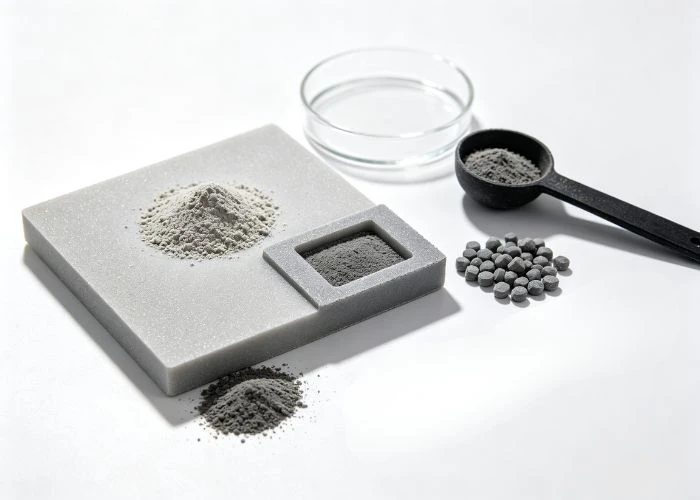
SLS works differently. It uses thermoplastic powder, most commonly polyamide materials such as PA12 or PA11. The powder surrounding the part supports the geometry during printing, which allows complex structures without conventional support features.
FDM uses thermoplastic filament and is another important part of the wider 3D printing market. However, UForProto’s plastic 3D printing capability focuses on SLA and SLS, so we do not present FDM as one of our manufacturing services.
For an engineering prototype, the important question is therefore not simply “Which plastic sounds strongest?” We need to understand the material system, the process that creates the part, and what physical behavior the prototype needs to represent.
Why Does the Printing Process Determine the Material Options?

The same design goal can lead to very different material choices depending on whether we use SLA or SLS. Each process requires a specific material form and creates the part through a different physical mechanism. As a result, surface condition, mechanical response, post-processing, and long-term behavior can vary even when two materials are marketed for similar applications.
SLA Uses Photopolymer Resins for Detail and Surface Quality
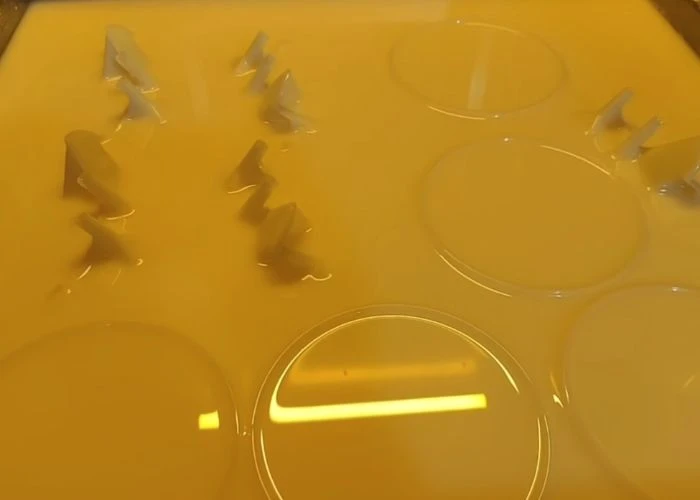
SLA materials begin as liquid photopolymers. During printing, selected regions are cured to form solid layers, and the finished part then requires cleaning and controlled post-curing.
The material range is broad. General-purpose, tough, durable, flexible, clear, high-temperature, and other specialty formulations allow us to match the printed part more closely to its intended prototype purpose.
One of the main reasons we use SLA in plastic prototyping is surface and detail. Fine features, product housings, cosmetic components, transparent concepts, and presentation models can benefit from the process.
Material and appearance must still be considered together. A clear resin, for example, does not automatically leave the printer with optical clarity. Surface preparation and polishing may be required depending on the visual requirement.
SLA materials also have limitations. Protolabs notes that UV and moisture exposure can change the appearance, dimensions, and mechanical properties of SLA materials over time.
For this reason, we normally use SLA material properties to answer a specific prototype question rather than assuming a resin will reproduce every long-term characteristic of a production thermoplastic.
SLS Uses Thermoplastic Powders for Functional Geometry
SLS uses thermoplastic powder rather than liquid resin. A laser selectively fuses the powder, while unsintered material surrounding the part provides support throughout the build.
This process-material relationship is particularly useful for complex geometry. Internal passages, clips, brackets, undercuts, interlocking features, and other difficult structures can often be produced without dedicated support structures.
Nylon is the dominant SLS material family. PA12 offers a useful balance of strength, durability, chemical resistance, and dimensional stability, while PA11 is generally considered when greater ductility and impact behavior are required.
SLS parts normally have a more textured surface than SLA parts. This is not necessarily a disadvantage when the prototype is primarily used for mechanical handling or structural evaluation.
The choice therefore depends on what matters more. If a customer needs fine cosmetic surfaces, SLA may provide a more direct route. If the project needs durable nylon geometry with complex features, SLS may provide better engineering value.
What Are the Most Common Plastic 3D Printing Materials?
Engineers often encounter material names before they understand the process behind them. To make material selection more practical, I prefer to group plastic 3D printing materials by process, expected behavior, and prototype use. This avoids comparing materials only by familiar commercial names and helps connect each option to the engineering question the prototype must answer.
Plastic 3D Printing Materials Comparison Table
| Material | Process | Main Characteristic | Typical Prototype Use | Main Consideration |
| General-Purpose Resin | SLA | Fine detail and smooth surface | Appearance models, housings | Limited material equivalence |
| Tough / Durable Resin | SLA | Improved toughness | Fit checks, housings, mechanical concepts | Still a photopolymer |
| ABS-Like Resin | SLA | ABS-inspired mechanical behavior | Product housings, prototype components | Not actual ABS |
| PC-Like Resin | SLA | Stiffness or temperature-oriented properties | Engineering concepts | Not actual PC |
| Clear Resin | SLA | Transparency | Clear housings, lenses, visual models | Finishing may be required |
| PA12 Nylon | SLS | Balanced strength and stability | Functional parts, brackets, clips | Textured surface |
| PA11 Nylon | SLS | Greater ductility | Flexible clips, impact-related parts | More flexible than PA12 |
| TPU | Powder-Based AM | Elasticity and flexibility | Flexible components | Process availability varies |
| PP | Selected Powder Processes | Low density and flexibility | Functional plastic components | Availability depends on platform |
This comparison should be treated as a starting point rather than a universal specification table. Actual performance depends on material grade, printer, build parameters, orientation, geometry, post-processing, and test conditions.
Formlabs likewise separates common 3D printing materials according to FDM filament, SLA resin, and SLS/MJF powder rather than treating them as one interchangeable plastic family.
HP’s current industrial portfolio also demonstrates how powder-based additive manufacturing has expanded beyond nylon into materials such as PP and flexible elastomers.
For UForProto projects, however, the important issue is not whether a material exists somewhere in the global 3D printing market. We recommend only processes and materials that match our actual SLA and SLS manufacturing capability and the customer’s prototype requirements.
How Should Engineers Compare Plastic 3D Printing Materials?
Material comparison should begin with the prototype requirement rather than a single datasheet value. Tensile strength alone does not tell us whether a material is suitable for a snap feature, cosmetic housing, hot environment, or repeatedly assembled component. I normally review mechanical behavior, environment, geometry, surface requirements, and the intended validation together.
Mechanical Performance Must Match the Prototype Function
Strength is only one part of material behavior. Stiffness, elongation, impact resistance, fatigue, hardness, and flexibility can be equally important depending on the design.
A rigid enclosure may need dimensional stability and stiffness, while a clip needs enough flexibility to deflect without cracking. Selecting the material with the highest tensile strength would not necessarily solve both problems.
For SLS parts, PA12 is often useful where balanced stiffness and durability are required. PA11 can become more attractive when the geometry needs greater ductility or repeated deflection.
SLA creates a different decision. A rigid resin may hold detailed geometry well, while a tough or durable formulation may be more suitable for handling, fit evaluation, or selected mechanical checks.
Formlabs’ material-selection guidance similarly compares properties such as tensile strength, flexural behavior, elongation, impact strength, and heat response rather than ranking materials through one number.
For us, the important question is how the material behaves in the actual prototype feature. The same property can have very different value in a housing wall, snap arm, bracket, button, or internal support.
Heat, Chemicals, and Environment Can Change the Material Decision
A prototype may perform well at room temperature and still fail to represent the intended application. Heat, moisture, UV exposure, oils, cleaners, and other chemicals can change polymer behavior.
This becomes particularly important for medical equipment housings, beauty devices, personal-care appliances, industrial equipment, and products that operate near motors, batteries, fluids, or heat sources.
I therefore want to know the environment before recommending a material for functional validation. A prototype used only for a short assembly review has very different requirements from one exposed to heat or chemicals.
Photopolymer resins require particular attention when long-term environmental behavior matters. Their properties may change with UV exposure or moisture, so a short-term prototype result should not automatically be treated as proof of long-term production performance.
If the environmental test must reproduce the behavior of a specific engineering thermoplastic, we may recommend CNC plastic machining from actual stock rather than relying on a printed analogue.
Are ABS-Like and PC-Like Resins the Same as ABS and PC?
No. This distinction is one of the most important points engineers should understand about plastic 3D printing materials. Terms such as ABS-like, PC-like, or PP-like normally describe a photopolymer formulation designed to approximate selected characteristics of a familiar thermoplastic. They do not mean that the printed material is chemically identical to conventional ABS, PC, or PP.
An ABS-like SLA resin may be formulated to provide a useful combination of stiffness, toughness, surface quality, or flexibility. That can make it very effective for prototype housings, fit evaluation, or design review.
However, actual ABS is a thermoplastic. An SLA ABS-like material is a UV-cured photopolymer. Their chemistry, processing history, aging behavior, impact response, thermal behavior, and environmental resistance are not automatically equivalent.
The same principle applies to PC-like resin. The name can help engineers understand the intended performance direction, but it should not be interpreted as proof that the prototype behaves exactly like a production polycarbonate component.
Protolabs’ SLA material documentation illustrates this clearly by describing multiple ABS-like, PC-like, and PP-like resins while separately comparing their properties with molded plastics.
This does not make these resins poor prototype materials. The opposite is often true. They can be extremely useful when the required prototype behavior matches the properties the resin is designed to provide.
The problem occurs when the material name is used as a substitute for understanding the validation objective.
For an appearance prototype, an ABS-like resin may provide exactly the surface, rigidity, and handling needed for a useful review. For a test that depends on actual ABS behavior under impact, temperature, chemicals, or long-term load, it may not provide equivalent evidence.
In those cases, CNC plastic machining gives us another route because we can machine the prototype directly from real engineering-plastic stock.
Which Plastic 3D Printing Materials Work Best for Appearance and Functional Prototypes?
The words “appearance” and “functional” help define the prototype objective, but they should not become rigid material labels. Some prototypes require excellent surfaces and limited mechanical handling, while others need durability without production-equivalent material behavior. I use these objectives to narrow the material options, then review the actual part geometry and test conditions.
Appearance Prototypes Usually Prioritize Surface and Detail
For appearance-focused plastic prototyping, SLA is often our first material-process route because its resin systems can reproduce fine geometry and provide a surface that responds well to further finishing.
Product housings, cosmetic covers, buttons, control panels, transparent components, and presentation models can all benefit from this combination.
The raw printed color is not always the final appearance. We can use sanding, surface preparation, painting, silk screening, UV-related finishing, and other processes when the customer needs a more production-like presentation.
Clear prototypes need particular care. Geometry may print successfully while optical appearance still requires polishing or other secondary work.
For this type of prototype, we therefore select the resin with the final finish in mind. A material that prints accurately but responds poorly to the required finishing route may not be the best overall choice.
This is an example of why material selection should extend beyond the printer itself. The finished prototype—not the raw print—is what the engineer or customer ultimately evaluates.
Functional Prototypes Need Material Behavior That Matches the Test
A functional prototype does not always require the final production material. It requires a material that represents the behavior being tested closely enough to support an engineering decision.
For a clip or bracket, SLS nylon may provide the durability and geometry needed for assembly evaluation. For a detailed housing that needs limited mechanical handling, a tough SLA resin may be sufficient.
If a test depends on a specific property of actual PP, PC, POM, ABS, PPS, or another engineering plastic, the requirement changes. A printed substitute may no longer provide the evidence the engineer needs.
This is where our ability to combine plastic 3D printing with CNC plastic machining becomes useful. Instead of forcing every prototype into one technology, we can select the manufacturing route according to the component’s role.
A multi-part prototype can even combine processes. A detailed outer housing may use SLA, a complex internal bracket may use SLS, and a critical structural component may be CNC machined from the required engineering plastic.
That approach allows each component to contribute the correct type of validation before the parts move into finishing or prototype assembly.
How Do We Select Plastic 3D Printing Materials for a Real Prototype Project?
When an RFQ reaches us, I do not begin by asking which resin name the customer wants. I first look at the CAD, prototype purpose, required quantity, material expectations, visible surfaces, critical features, finishing requirements, and assembly scope. These details help determine whether an SLA resin, SLS nylon, CNC-machined plastic, or combined manufacturing route is more appropriate.
The Prototype Requirement Comes Before the Material Name
If the prototype is mainly for visual review, I focus on detail, surface quality, finishing compatibility, and the way the customer will present or handle the part.
If the prototype contains clips, flexible features, brackets, or complex internal geometry, mechanical behavior and the advantages of SLS may become more important.
If the customer specifies ABS-like material because the production part will eventually be ABS, I want to understand why ABS matters. If the goal is appearance and general handling, a suitable SLA resin may work well.
If the test specifically depends on real ABS material behavior, I would evaluate machining the prototype from ABS stock instead.
The same reasoning applies to other materials. The material specification only becomes meaningful when we understand which property is important to the product.
This prevents over-specification while also reducing the risk of selecting a convenient material that cannot provide useful engineering feedback.
Material Selection Should Include Finishing and Assembly
A prototype part rarely exists in isolation. It may need sanding, painting, graphics, bonding, fastening, or assembly with customer-supplied components.
These downstream requirements can change the best material decision. A resin selected only for its printed properties may create unnecessary difficulty during finishing or assembly.
For a cosmetic prototype, we need to know which surfaces remain visible after assembly and which interfaces must remain controlled after painting.
For an assembly prototype, we also need to understand mating features, fastening points, flexible elements, and how repeatedly the customer expects to assemble or remove components.
At UForProto, we handle these questions as a direct plastic prototype manufacturer rather than a trading company. Our manufacturing scope includes SLA and SLS 3D printing, CNC plastic machining, vacuum casting, surface finishing, and complete prototype assembly.
This lets us review a project as a physical prototype build rather than treating material selection as an isolated purchasing decision.
Engineers, R&D teams, product designers, and buyers can send us CAD files, drawings, quantity, material expectations, surface requirements, and assembly information for engineering review and quotation.
When Is a 3D Printed Material Not Representative Enough?
Plastic 3D printing materials are extremely useful when their properties match the question the prototype needs to answer. Problems occur when a convenient printed material is expected to reproduce behavior it was never designed to represent. I therefore separate geometric validation from material-specific validation before deciding whether additive manufacturing provides enough engineering evidence.
If a customer needs to evaluate appearance, ergonomics, packaging space, general assembly, or complex geometry, the exact production polymer may not be necessary.
If the prototype must reproduce the behavior of actual ABS, PC, PMMA, PP, POM, PA66, PPS, or PE, material equivalence becomes much more important.
Long-term loading is one example. A resin that feels sufficiently rigid during a short design review may not represent the creep behavior of the production thermoplastic.
Temperature is another. A prototype near a motor, battery, heater, or other thermal source may require material behavior that a general printing resin cannot represent.
Chemical exposure creates the same concern. Medical, personal-care, beauty, and industrial products may contact cleaning agents, oils, fluids, or other chemicals.
Critical mechanical interfaces may also favor actual engineering plastics. Threads, bearing areas, sliding surfaces, precision mating features, and structures exposed to repeated load can depend strongly on the real material.
In these situations, CNC plastic machining can provide a more direct route because the part is cut from actual engineering-plastic stock rather than a material designed to imitate selected properties.
This is not a reason to choose CNC for every functional prototype. It is a reason to match the manufacturing process to the evidence the engineering team needs.
Conclusion
Plastic 3D printing materials should be selected according to what the prototype must prove, not simply by familiar material names. SLA resins provide excellent detail, surface quality, and specialized formulations, while SLS nylons offer durable thermoplastic behavior and freedom for complex geometry. ABS-like or PC-like resins can be valuable prototype materials, but they should not be treated as identical to conventional ABS or PC. When actual engineering-plastic behavior is critical, CNC plastic machining may provide more representative validation. If you are developing a plastic prototype, send UForProto your CAD files, drawings, material expectations, finishing requirements, quantity, and assembly information for engineering review and quotation.
FAQs
1. What Are the Most Common Plastic 3D Printing Materials?
Common plastic 3D printing materials include SLA photopolymer resins, SLS nylon powders such as PA12 and PA11, FDM thermoplastic filaments, TPU, and PP on selected powder-based platforms. The available material depends on the printing technology, so engineers should evaluate the process and material together rather than comparing material names alone.
2. What Material Is Used for SLA 3D Printing?
SLA uses liquid photopolymer resins that cure when exposed to controlled light. Available formulations can emphasize detail, toughness, flexibility, transparency, temperature resistance, or other properties. These materials are thermoset photopolymers and should not automatically be considered identical to conventional thermoplastics.
3. What Material Is Used for SLS 3D Printing?
SLS commonly uses thermoplastic powder, particularly PA12 and PA11 nylon. PA12 provides a useful balance of stiffness, durability, chemical resistance, and dimensional stability, while PA11 is generally more ductile. Other powder-based additive systems may also process TPU, PP, or reinforced nylon materials.
4. Is ABS-Like Resin the Same as ABS Plastic?
No. ABS-like SLA resin is a photopolymer formulated to reproduce selected characteristics associated with ABS, such as stiffness or toughness. Conventional ABS is a thermoplastic with different chemistry and processing behavior. An ABS-like resin may be excellent for a prototype, but it should not automatically be used to validate every material-specific property of actual ABS.
5. What Is the Best Plastic 3D Printing Material for Functional Prototypes?
There is no single best material. SLS PA12 may suit durable brackets, clips, and complex structures, while PA11 can be useful where greater ductility is needed. Tough SLA resins can support selected mechanical checks where detail and surface quality also matter. The best choice depends on the specific function being evaluated.
6. When Should I Use CNC Plastic Machining Instead of a 3D Printed Material?
CNC plastic machining becomes more appropriate when a prototype must represent the behavior of a specific engineering plastic, requires controlled machined interfaces, or depends on properties a printed substitute cannot reproduce reliably. It allows us to manufacture directly from actual ABS, PC, PMMA, PP, POM, PA, PPS, PE, and other engineering-plastic stock.